

The folk arts, in their original and earlier period, expressed the joy of creation and the healthy and profound optimism of the people. Their prime purpose was to satisfy the people’s needs and requirements. This is true of the exterior carving of the Russian izba and ornamentation of the Ukrainian khata, and the woven carpets and rugs that decorate the yurtas of the Kirghiz and Turkmen nomads. The folk arts and handicrafts of the Soviet peoples include the multicolored homespuns of the North and Nizhni-Novgorod and the picturesque national costumes of the Russians, Ukrainians, Byelorussians, Mordvins, Maris, the Crimean and Kazan Tatars, and the nomadic and hunting tribes; they include folk jewelry, carved ivory, gold and colored brocade, delicate lacework and embroidery and woven fabrics of noble hue and design.
But the folk arts declined under the influence of capitalist culture and were ousted by its cheap and vulgar shoddy, its stereotyped production and machine standardization.

by Chukchi Artists
Prior to the October Socialist Revolution, the folk artists and handicraftsmen in Russia were obliged to work, not for the people, but for the capitalist market, for an indifferent consumer with debased and often perverted tastes. Ruthless exploitation had almost transformed the craftsman into a slave, and had depressed not only his living standard but also his artistic standard. Folk art was pressed into the production of drawing-room knickknacks. Folk traditions retreated before the chance tastes of fashionable artists and the caprices of fickle modes. The folk artist lost his independence as a creative worker and was transformed into an artizan, a slavish copier of the specimens of bad taste sent him for execution.
The victory of Socialism in the U.S.S.R. created the conditions for a revival of the folk arts and handicrafts by emancipating peasant life both socially and economically and organizing its productive forces on collective lines. A widespread system of co-operative handicraft societies was created which took upon itself the duty of fostering and encouraging the folk arts. The craftsmen united to form artels (co-operative producing groups). Their output is now increasing with unusual rapidity from year to year. Profound interest is shown in the cultural and professional needs of the craftsmen, and especially in their artistic development and the revival of the basic features of folk art. The purpose is not only to revive and preserve the finest traditions and technique of the crafts but to raise them to a higher artistic plane. A diversified system of training young craftsmen has been devised, from apprenticeships in the workshops of the artels to craft schools and industrial art colleges.
Quite an important part is also being played in the development of folk art by institutes that have sprung up since the revolution, like the Industrial Art Institute in Moscow and the Experimental Craft Workshops in Kiev, which make a study of the handicraft industries in various parts of the country, offer instruction and advice, and enlist craftsmen for experimental work. Development is also considerably stimulated by the organization of socialist emulation and of contests between groups and districts.
Prizes and diplomas are offered for outstanding work, and distinguished craftsmen may earn the official titles of Master of Folk Art and Artist of Merit. The best of them are ranked with acknowledged masters in the professional arts.
It was under the Soviet government that the folk art of the U.S.S.R. won its first international triumphs. Special mention should be made of the high distinctions and appreciation earned at the Paris World Exhibitions of 1925 and 1937.
The folk arts of the peoples of all the eleven constituent republics of the U.S.S.R. reflect the Socialist culture, displaying it in peculiarly national forms in astonishing richness and variety.
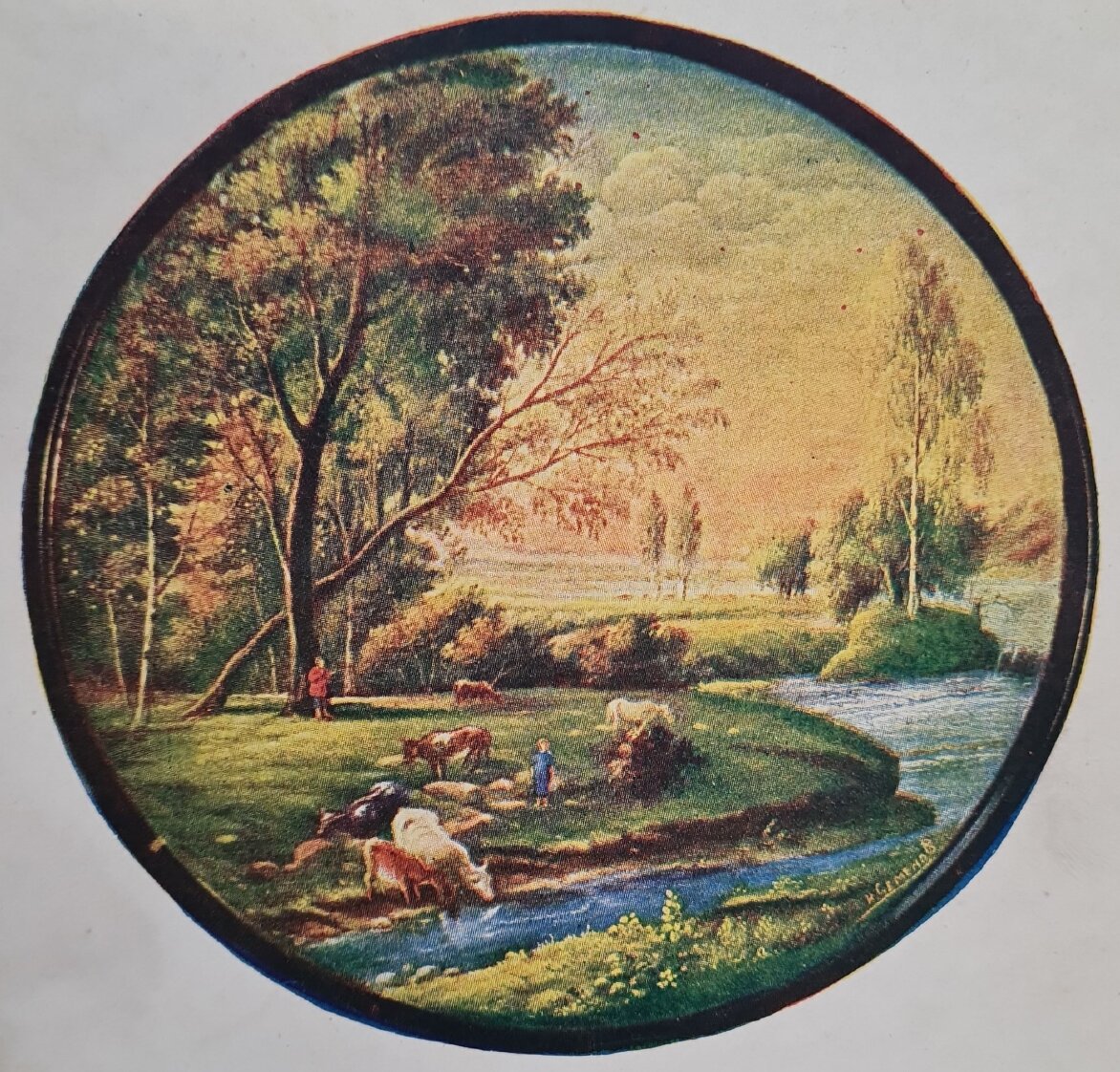
The environs of Moscow, the capital of the Soviet Union, are the home of an outstanding group of folk handicrafts. Here prior mention should be made of the famous lacquered papier-mâché work for the peasant artel of Fedoskino, a village near Moscow, where the old traditions of this valuable craft are not only being guarded, but also improved and developed. The charm of Fedoskino lacquer work lies in its irreproachable quality of material and finish and in the beauty of its painting. It is distinguished by its vividness and freshness of coloring and intimacy of design, which embodies both the old traditional subjects and new themes suggested by Soviet life. The lacquer miniatures of Fedoskino are marked by realism, a spirit of joy and decorative taste. They are in wide and popular demand.
Even closer to the national style are the painted trays of the Zhestovo and Novosiltzevo artels, whose productions enjoy an enduring popularity for their virtuosity, their simple yet bold design, the strength, precision and confidence of their brushwork, and their broad decorative quality.
The villages of Abramtsevo, Kudrino and Akhtyrka, near Moscow, are noted for their wood carving, including furniture decorated with carvings in the folk style, often of considerable taste and effect. The craftsmen of Bogorodsk used to specialize in carved wooden toys, but are now going in more and more widely for carvings illustrating subjects drawn from folklore and from the life of the collective farms and the Red Army.
Rostov, an ancient town in the Yaroslavl Region, with a picturesque Kremlin, is the home of an artel of enamel painters, who produce decorative brooches, boxes and cigarette cases with delicate miniature designs.
The three villages of Palekh, Mstera and Kholui, in the Ivanovo Region, were before the revolution famous centers of icon-painting, but have since become homes of a new folk art. Their skilled craftsmen, depositaries of the ancient art of icon-painting, were prompted by the Soviet government and public interest to turn their traditional skill to the depiction of new subjects drawn from modern Soviet life, and within a few years developed a remarkable art of new form. Palekh work has won wide renown. The craftsmen of Mstera and Kholui have gone even farther along the road of realism, while at the same time preserving the best and most valuable features of their traditional folk art. They particularly excel in highly ornamental landscapes, executed with great feeling and serving as a background for scenes from the vigorous, healthy and happy Soviet life of today.
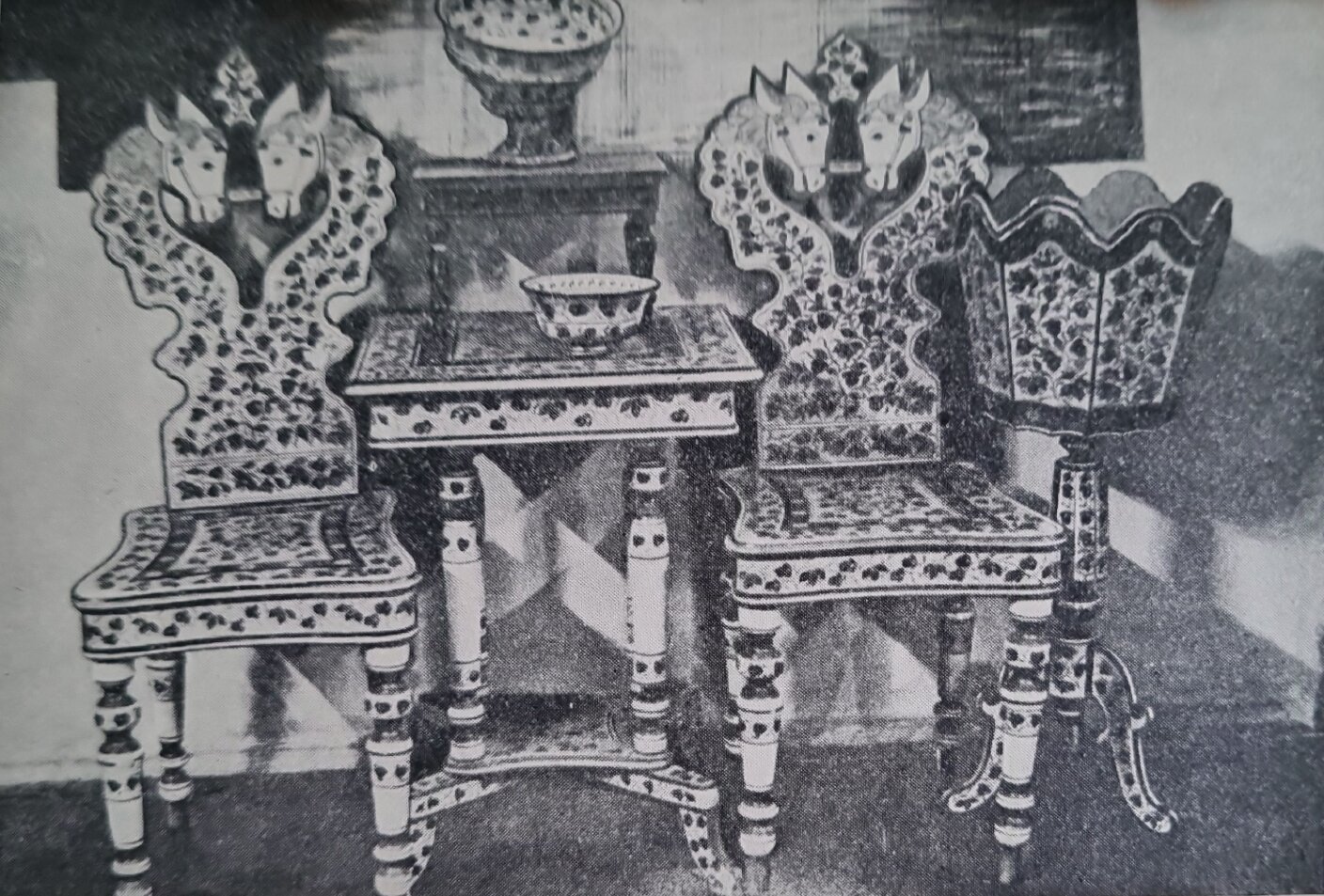
Khokhloma is a village in the remote forest district of the Gorky Territory. Its craftsmen produce wooden articles painted by hand on a lead ground and covered with a layer of oil varnish. The effect is one of iridescent gold, flaming vermilion and deep velvety blue and black serving as a background for ornamental patterns laid on with a bold and confident brush. The style of the Khokhloma craftsmen had formerly been debased by gross and tasteless, so-called “modern,” motifs, but the revolution has directed it back to its original folk source—patterns of flowers and foliage—from which the craftsmen have been fertile in developing new motifs and designs.
Very much the same is true of the craftsmen of Shemogod in the North, whose work is known all over the world. With a keen knife, and without any preliminary drawing, they carve in birch bark designs of great intricacy and beauty based on realistic motifs.
Not far from Shemogod lies the ancient town of Veliki Ustyug, where the niello method of silver ornamentation has existed for centuries. The secret had almost been lost before the revolution, but an old craftsman, the last depositary of the art, has since collected a group of young people around him and transmitted to them his knowledge and experience. An artel was formed which now produces jewelry of remarkable beauty. On a smooth silver background are depicted, in dark-blue silhouettes and lines, flowers, fruit, northern landscapes and cities, scenes of Soviet construction, incidents from the revolution and portraits of famous people.
Still farther to the north, on the very shores of the White Sea, in Kholmogori, the birthplace of Lomonosov, the great Russian scientist, there is now once more developing a no less ancient art, ivory carving, which before the revolution had almost died out. With the help and encouragement of the local Soviet and trade unions, three of the old craftsmen started a school in the art, and there is now quite a group of young craftsmen who do the most delicate work on ivory and sea-lion tusk. They are most successful in carving northern scenes in relief, but they are also expert in miniature sculpture.
A second ivory-carving center has been restored in Tobolsk, where in recent years young craftsmen have been producing group compositions depicting, with great simplicity, strength and fidelity of form, the life of the northern Soviet peoples, their cultural progress and their share in the political life of the country.
Further to the north-east, in Chukotka near Cape Wellen, the scene of the Chelyuskin epic, there is a third ivory-carving center. The craftsmen are native Chukchis and it is difficult to imagine greater laconism of style, yet complete artistic realism, than displayed in their carvings of animals of the Far North. In addition to being good carvers, these Chukchi artists are masters of design. Their designs charm us by their fidelity to life, the keen observation they reveal and their precision of form. Their subjects are the life and habits of the Chukchis, northern landscapes, the rescue of the Chelyuskinites, and portraits of Lenin and Stalin.
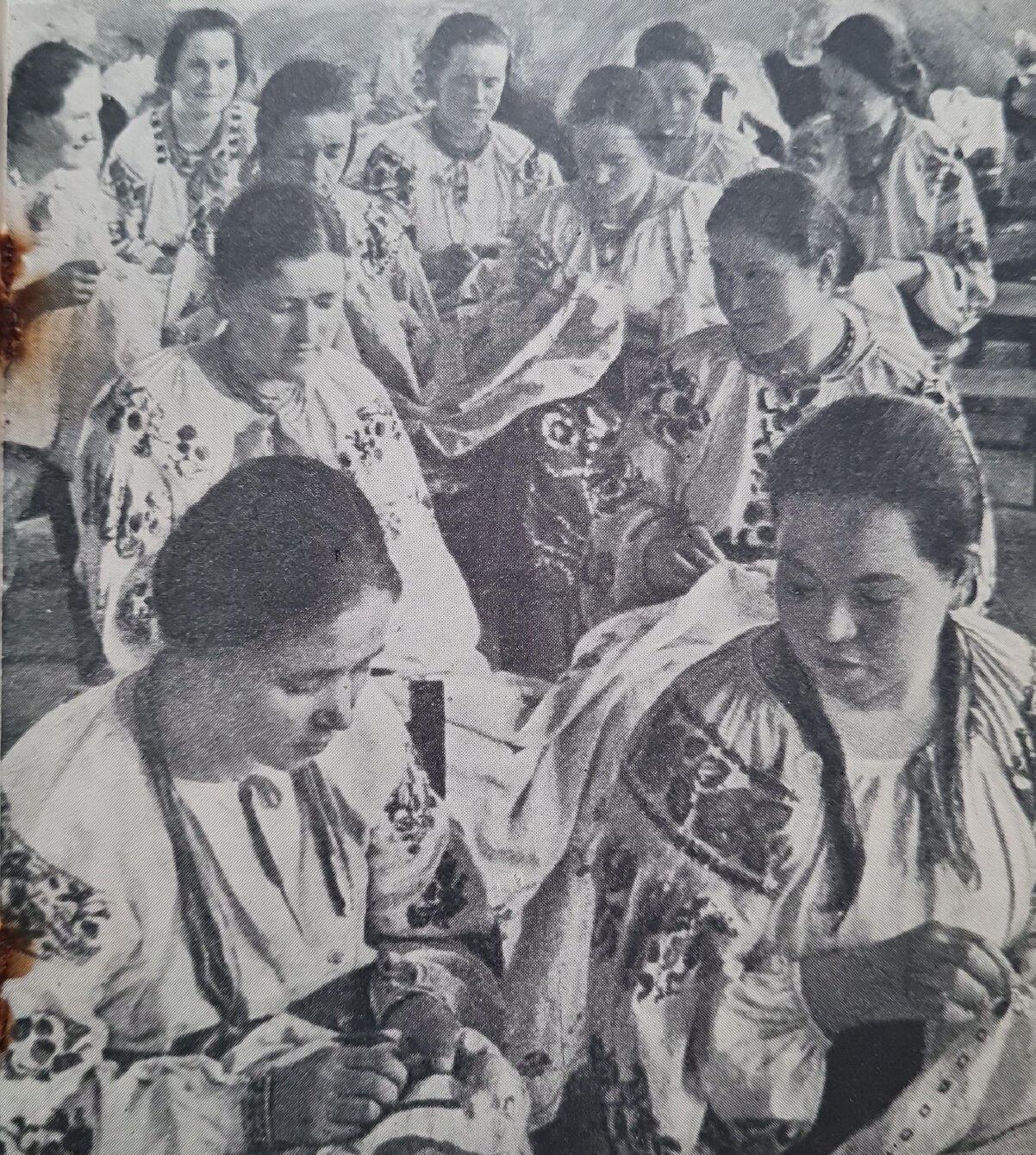
Let us now turn from the Siberian shores of the Arctic to the more genial land of the Ukraine. Here too we find folk arts and crafts revived by the revolution. The carpets of the Ukraine, with their magnificent designs of foliage executed on orange, puce and sky-blue backgrounds, are no longer the only product of her handicraft industry. Craft artels now weave expansive tapestries depicting the abundance of the Soviet land and the happy life of its folk, the exploits of the Red Army, and the great leaders of the revolution, Lenin and Stalin. The splendid rugs of Krolevetz astonish and delight the eye with their original designs and new achievements in coloring. Ukrainian embroidery, in all its variety and beauty, is being adapted to new women’s styles based on the original national costume. Ukrainian pottery is in a period of vigorous renaissance.
No less striking is the revival of the crafts of weaving and embroidery in Byelorussia.
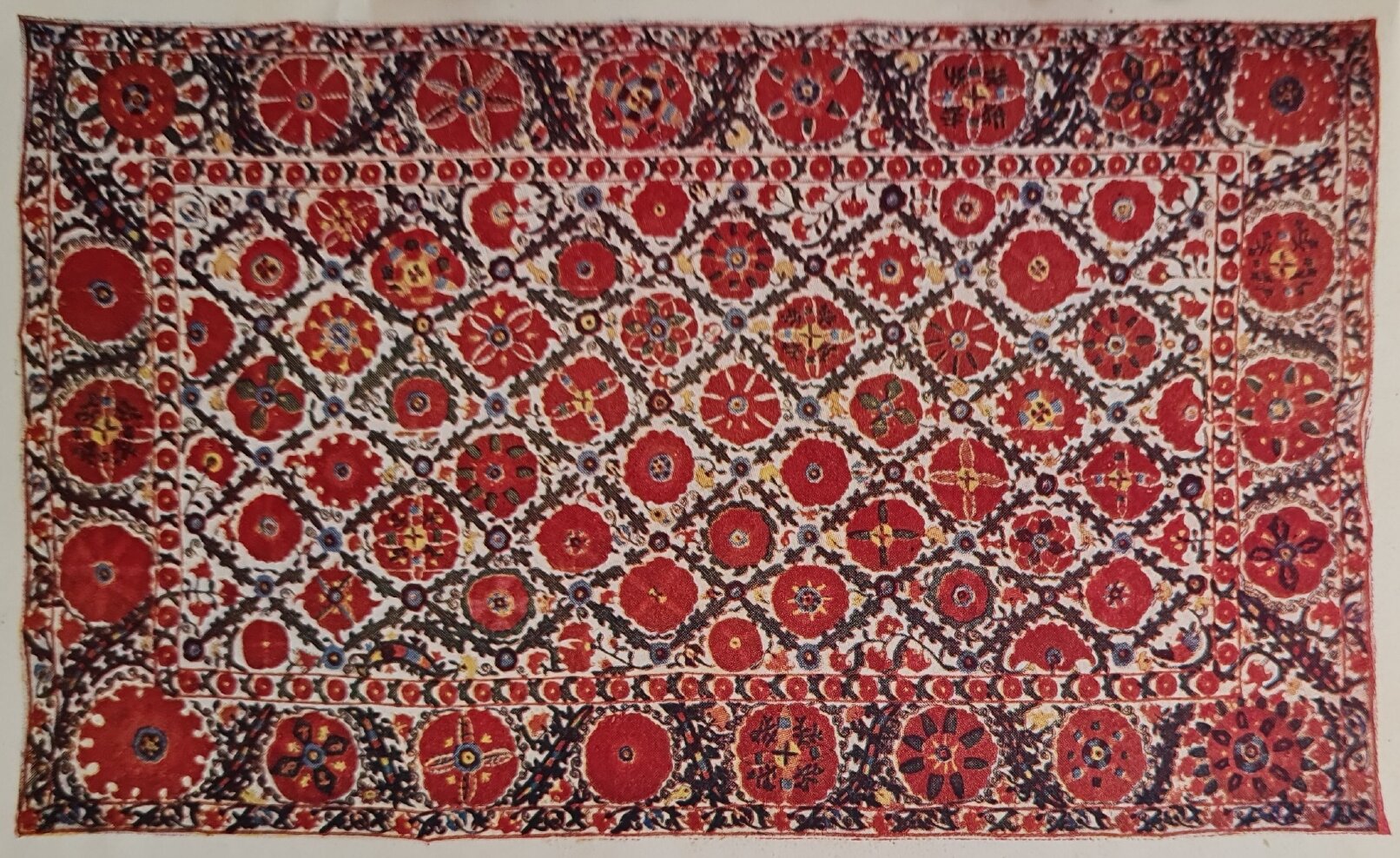
Soviet Central Asia excels in siuzanè, the native embroidery—which entices the eye with its original designs and hues—in wood carving, in the traditional craft pottery, and in metal ornaments. The rugs of Turkestan abound in new designs, symbolic representations of Soviet themes.
Equally rich and varied are the native arts of the Caucasus and Transcaucasus. The metal workers of the village of Kubachi, perched high in the mountains of Daghestan, while jealously preserving the century-old traditions of their craft, produce astonishing new combinations of niello-work, engraving and gold inlay on steel and ivory. They make abundant use of their traditional themes, which were almost forgotten before the revolution owing to lack of demand, but, like the Russian craftsmen, are lending greater richness and variety to them. They are now attempting complex composite themes expressive of the new Soviet life. The rugs and carpets of Daghestan and Azerbaijan are acquiring greater fidelity to the strict features of folk art, discarding their former eclecticism and adulterations of style induced by alien and commercial influences.
In Georgia and Armenia, the revival of the native crafts is most apparent in carpet weaving, in which new foliage designs are being successfully combined with the traditional motifs that formerly used to be employed both in carpet weaving and in the ancient art of miniature.
This survey, though brief and far from complete, will nevertheless show the flourishing state of the folk arts and crafts in the U.S.S.R. Demands of unprecedented extent are being made on the decorative arts for architectural purposes in connection with the tremendous development of cultural constructive work in the U.S.S.R.; and they are already finding a keen and eager response among the folk artists and craftsmen. The masters of Palekh and Mstera are employed in deocrating and painting panels for Palaces of Culture, workers’ clubs, Houses of Young Pioneers and theaters.
The Agricultural Exhibition which is to open in Moscow in 1939 will make wide use of the services of folk artists and craftsmen for the decoration of the pavilions. Immense work will be required on the decoration of the Palace of Soviets now in course of construction in Moscow. Here the utmost scope will be given to the creative initiative of the masters of folk art and for their collaboration with the finest architects, sculptors and painters of the first Socialist country in the world.