



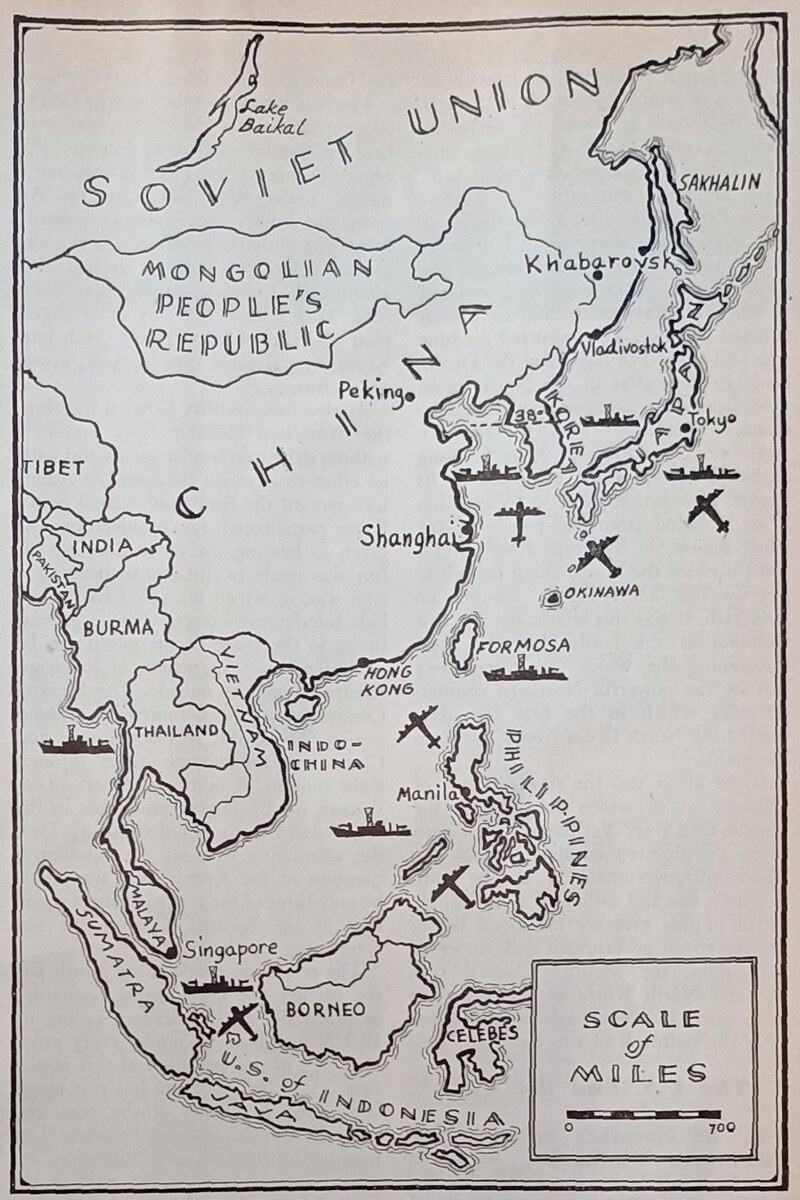
It is generally acknowledged that in ordering military intervention in Korea and Formosa President Truman capitulated to his critics on the extreme right flank of American politics. Not in many months has Senator McCarthy been so quiet, so docile. He must be a very happy man. For as the American government becomes more and more heavily involved in this newest colonial war it becomes increasingly evident that it has taken another long stride on the road to fascism and World War III.
Prior to June 25, when the Korean War broke out, there was little if any difference between the administration and its critics on the extreme right on the fundamental issues of foreign policy. There was, on the contrary, full agreement that the cold war against socialism, against the people’s democracies and against genuine colonial liberation had to be relentlessly pursued. There was agreement that any thought, institution or movement which opposed atom-bomb diplomacy or fought against fashioning the world after the pattern of Wall Street should be “branded” as Communism and suppressed, if necessary with violence.
Between the administration and the McCarthys there was, however, a difference of opinion as to how the fundamentals should be achieved. This was clearly illustrated in the case of the Far East where by last fall the issues had become pivoted on the island of Formosa. At that time General MacArthur, Herbert Hoover, Senators Taft, Smith, Ferguson, Knowland and others of the far right advocated immediate armed intervention in Formosa. The administration rejected this line in favor of a longer term assault upon the Chinese People’s Republic through encirclement on a wide arc stretching from Japan through the Philippines to the Malay Peninsula and India.
President Truman apparently disposed of the issue when on January 5 of this year he declared:
The United States government will not provide military aid or advice to Chinese forces on Formosa. The resources on Formosa are adequate to enable them [the Chiang Kai-shek forces] to obtain the items which they might consider necessary for the defense of the Island.
On the same day Secretary of State Dean Acheson backed up the President’s statement with an extraordinary prediction:
We are not going to get involved militarily in any way on the island of Formosa. So far as I know, no responsible person in the government, no military man has ever believed that we should involved our forces in the island.
Acheson on the same occasion made the following sanctimonious declaration which, were he a more ordinary human being, would surely disturb his conscience today:
The Chinese have administered Formosa for four years. Neither the United States nor any other ally ever questioned the authority of that occupation.…We are honorable and decent people. We do not put forward words, as propagandaists do in other countries, to serve their advantage, only to throw them overboard when some change in events makes the position difficult for us.
On June 27, simultaneously with ordering military intervention in Korea, President Truman reversed and contradicted all that he and his Secretary of State had declared on January 5. On June 27 he said:
…the occupation of Formosa by Communist forces would be a direct threat to the security of the Pacific area and to United States forces performing their lawful and necessary functions in that area. Accordingly I have ordered the 7th Fleet to prevent any attack on Formosa. As a corollary of this action I am calling upon the Chinese government on Formosa to cease all air and sea operations against the mainland. The 7th Fleet will see that this is done. The determination of the future status of Formosa must await the restoration of security in the Pacific, a peace settlement with Japan, or consideration by the United Nations.
Thus like the “propagandists,” ridiculed by Acheson six months ago, the American government did in fact “put forward words” to serve its advantage “only to throw them overboard when some change in events (made) the position difficult for us.”
The conservative New York Herald Tribune columnist, David Lawrence, notes that “The new policy in the Far East is, to be sure, a reversal” and adds that “the main defect in the Truman-Acheson policy which has led to such severe attacks from Senators Knowland, of California, and Alexander Smith, of New Jersey, and Representative Judd, of Minnesota—all Republicans—has been corrected at last.” Bert Andrews, writing in the same newspaper, comments that the new policy “almost amounts to ‘vindication’ of the attitude taken” by MacArthur, Hoover, Taft, Smith, Ferguson and Knowland.
Harmony reigns today between the Truman-Acheson administration and their pro-fascist critics. This state of bliss has been achieved by bringing the United States into a war on the other side of the Pacific where, we are asked to believe, the United States has been attacked. It has been achieved by bringing the armed might of the richest nation on eaerth to bear against 30 million Koreans in order to impose upon them against their will “a little Chiang Kai-shek” who is completely subservient to the most dangerous elements in America.
The American people know very little about the Korean question and practically nothing about the background of the present war. They have for the most part been unaware of the shameful story of the American Military Government in Korea, of the type of puppets who were forced upon the South Koreans, of the incredible brutality of that regime, of its open and continual demands for war against North Korea, of the disgraceful role played by the United Nations Special Commission on Korea which had been forced upon the UN by n o less a person than John Foster Dulles as American delegate and which in Korea had time and again been made to knuckle down to American orders. How many Americans know that for some time now the Korean people themselves have been saying that the Americans were worse than the Japanese ever were? How many Americans recall that as recently as March of this year the New York Times Korea correspondent told us that “large sections of South Korea are darkened today by a cloud of terror that is probably unparalleled in the world?” How many Americans noted a small item in the New York Post for this July 8 in which Lieut. Col. Thomas MacClure, who spent four years in Korea with U.S. Military Government, warned that it would take at least 100,000 Americans and a year “before the Korean war is won” because “the South Koreans hate us,” and that “our biggest danger will be sabotage and ambush” from the Korean people themselves?
Elsewhere in this issue the reader will find the points mentioned in the paragraph above documented. Gradually the true picture of the situation will become more widely known, but meanwhile the bi-partisans in Washington have enjoyed an enormous initial advantage because of the widespread ignorance on the Korean issue. They have faked and fabricated “information,” they have suppressed vital facts, they have shocked and stampeded large sections of the country into believing the utter nonsense that this was a patriotic cause, they have abused and misused the United Nations so that this potentially great body has committed a major crime against peace and justice, and they are now turning the “crisis,” which they themselves have created, against the trade unions and against all groups and individuals who dare to stand up in protest. And all of this, characteristically, is being done in the name of its opposite, peace and democracy!
Who Started Korean War?
Who was responsible for inciting civil war among a people who for generations have been struggling to achieve unity and independence? Who was the aggressor?
These are important questions, for American intervention and United Nations military sanctions are premised upon North Korean guilt. Yet a moment’s reflection must bring all honest-minded people to the realization that no examination of this question has been made, no evidence—let alone impartial evidence—has been presented or even requested. The civil war broke out early on June 25. Immediately the Syngman Rhee regime of South Korea alleged that they had been attacked without provocation. Simultaneously, it would seem, the American government knew all about it, branded North Korea as the aggressor, and within a few hours had the United Nations bringing a verdict of guilt without examination or trial.
There is an abundance of circumstantial evidence at hand bearing on the question of who incited the Korean war. Much of it will be found in other articles in this issue. The evidence is incontrovertible that the United States, ever since September, 1945, has consistently been manipulating the Korean situation as a pawn in its struggle to dominate the Far East and in its cold war against the Soviet Union and the people’s democracies. The evidence is incontrovertible that ever since 1945 the United States has been seeking to foist upon Korea a corrupt, feudal-fascist regime having no popular support whatsoever, no roots among the people but, instead, being so hated by the Koreans that it could maintain its rule only through the brutality of a police state.
There is evidence in abundance to support these statements; there is none to the contrary. Every correspondent, every writer, every visiting delegation has provided testimony in proof of these conclusions.
Why was none of this given a moment’s consideration by the American government or by the Security Council before declaring North Korea the aggressor? Why did not the Security Council pause just long enough to study the reports of its own Commission in Korea? Even that pro-American body had previously provided a great deal of data pointing to quite a different conclusion as to the origin of the Korean civil war. Its reports to the UN alleging that the North was the aggressor were based on no first hand evidence, but solely on the word of the Rhee regime. And it should be noted that the part of the Commission now remaining in Korea (the rest is in Japan) is headed by a representative of Chiang Kai-shek.
Direct evidence confirming the statement of the North Korean Government that the attack was launched by the South is contained in the New China News Agency Bulletin of June 26 (London office). A dispatch from the correspondent in Pyongyang said:
Two days before they launched an attack north of the 38th parallel, troops of the South Korean puppet government continueously bombarded Bek Sung county town in Hwang Hai province in North Korea with artillery fire, states the Korean Central Telegraphic Agency.
They shelled Dai Dong in Cu Bek Sung county, with more than 200 shells from 125 millimeter howitzers and 81-mm. mortars from 10 p.m. on June 23 to 4 a.m. on June 24. More than 200 howitzer and mortar shells were fired on the Ka Ga Ku area of Bok Shing county from 12:25 a.m. on June 23. More than 200 shells were also fired on the Ka Ga Yu area from 6 to 10 a.m. on June 24.
Scores of peasant homesteads in the Ben Sung region were demolished by the shelling, while 13 peasants were wounded. Six policemen of the Republic were wounded and one was killed.
Indeed, charges of attacks from the South had been heard over the Pyongyang radio all through May and June. On May 26, the North Korean radio claimed violations of the 38th parallel by Southern forces in five counties between May 19 and 22; on June 3 and 6 it announced twenty-five other attacks by the South.
In addition to the background material presented elsewhere in this issue, other evidence of a fairly direct nature can be given in the form of aggressive declarations by the government leaders of South Korea whom the Americans themselves placed and held in power.
Syngman Rhee, the “little Chiang Kai-shek” of South Korea, declared in December 1946: “On returning to Korea I advocated unification to make the world think we were united, so that we could drive the Russians from the north. America is our friend…. We must fight those who are not our friends. As soon as the time comes, I’ll instruct you. Then you should be prepared to shed blood.”
A former Minister of Home Affairs, Yun Chi Yong, told a press conference on March 9, 1949, that “The only way to unify South and North Korea is for the Republic of Taehan to regain the lost land in North Korea by force.”
A dispatch from Allen Raymond in the New York Herald Tribune of August 5, 1949, generalized as follows about South Korea military intentions: “The one outstanding thing about the South Korean army, now it has been purged several times of Communist infiltrators, is its outspoken desire to take the offensive against North Korea. It wants to cross the border. Its best officers are Japanese-trained professionals, with a fine frosting of American Army training.”
On November 1, 1949 the New York Herald Tribune carried a significant UP interview with the South Korean Defense Minister, Sihn Sung Mo, in which it was reported that “Referring to the readiness of his troops to drive into North Korea, Mr. Sihn expressed confidence that they could wrest control from the Communists. ‘If we had our own way we would, I’m sure, have started up already,’ he told a press conference. “But we had to wait until they [American government leaders] are ready. They keep telling us, “No, no, no, wait. You are not ready”’ … ‘We are strong enough to march up and take Pyongyang [the northern capital] within a few days,’ he said.”
On March 2, 1950, according to the New York Times, President Syngman Rhee told the Korean people that despite advice given by “friends from across the seas” not to attack the “foreign puppets” in North Korea, the cries of “our brothers in distress,” in this north could not be ignored. “To this call we shall respond.”
One does not have to stretch the imagination to question whether the purpose of John Foster Dulles’ visit to the South Korea government leaders a few days before hostilities commenced was not to inform them that the time had come, that the American governemtn leaders “are ready.”
Who Has Sought Peaceful Unification?
Evidence of opposite intentions comes from North Korea. From there has come a consistent appeal for peaceful unification of the nation. It has come from the North not because peaceful unification is a policy held exclusively by the people of that area, but because the oppression in the South had created a situation in which only in the North could the national aspirations of the whole nation be voiced and advocated.
It became clear as early as 1945 that Korean aspirations for a sovereign, democratic and unified government were inconsistent with the American desire to establish a closely controlled puppet regime, based upon feudal landholding and the foreign (American) ownership of industry and raw materials, which would serve as a willing tool in the cold war.
An equally clear picture of the policy of the Soviet Union emerged. The Soviet Union encouraged and gave suppport to a modernization and democratization of Korea, which meant ousting the landlords and collaborators from power in favor of the peasantry, the industrial workers, the small merchants and intellectuals who went along on a program of people’s democracy.
The clash between these two concepts, the American and the Russian, was particularly sharp over the issue of treating the Japanese enemy. To achieve its purposes the United States at first ruled through the Japanese apparatus itself and then gradually shifted from that apparatus to its shadow, the Korean puppets and collaborators of Japan. Thus under American rule the archaic feudal institutions and customs were kept intact and even strengthened and all tendencies toward genuine reform were ruthelessly suppressed. In the North the Russians depended upon the people’s committees which had taken matters into their own hands even before either the Russian or American troops had arrived and supported them in a program of rapid and drastic modernization.
Under such contrasting international influences it came about that only in the North could the democratic and sovereign aspirations of the whole Krean people be voiced and advocated. In fact it was the very strength and effectiveness of the peaceful unification movement which according to the North Korean leaders, caused the Syngman Rhee regime to open military hostilities on June 25.
The background of the development of the Korean unification movement is included in another article. Here, because of the pertinence to the question of what and who caused the war, we shall outline only the recent manifestations of that movement.
More than two years ago, in April 1948, a joint conference of political parties and social organizations of both South and North Korea was held in order to plan elections for a national government. This plan was nullified by the insistence of the United States and the UN Commission, which was American inspired and American dominated, upon procedures which assured separated elections in South Korea.
In June, 1949, seventy-one parties and organizations from the North and South formed themselves into a Democratic Front for the purpose of attaining peaceful unification through the holding of general, national-wide elections. In the South the plan was again truncated by the brutality of the Rhee government which arrested, imprisoned or executed all on whom it could lay its hands who dared to challenge its undemocratic ways.
Finally, during the first three weeks of June of this year, the Democratic Front, able to speak only through its leadership in the North, made another strong bid for peaceful unification. The gist of the new proposals was that the legislative bodies of the North and South unite to adopt a constitution under which a general election would be held for a nationwide governing body. This election was to be completed by the middle of August, marking the end of five years of trusteeship since the Japanese surrender and the beginning of Korea’s life as a sovereign, democratic nation.
The Syngman Rhee government responded to this proposal by instituting a reign of terror unusual even in that reign of terror unusual even in that bloody regime’s history. Any one who so much as received the plans of the Democratic Front was branded a traitor. Finding itself unable to place its proposals effectively before the people of the South, the Democeratic Front publicly announced that it was sending three of its leaders from the North to Seoul, the Southern capital, in order officially to lay these proposals before the South Korea legislature. Upon attempting to cross the Thirty-eighth Parallel the three emissaries were fired upon. They survived this provocation and were seen to pass through the border station. They were then arrested by Rhee’s military police and have been unheard of since. This occurred on June 10th and 11th. Ten days later the Democratic Front leaders in the North again announced their intention to send a delegation to Seoul.
According to Premier Kim Ir Sung of North Korea, as an extension of its former provocations and in desperation at its isolation from the people of the whole nation, the Syngman Rhee government invaded the North along the whole line of the Thirty-eighth Parallel on June 25th. It was this attack, not the first violation of the border but the most threatening one, which was immediately met by the powerful Northern counter-offensive which in the first few days carried the North Korea troops well into the South.
Is not all of this the strongest sort of evidence as to which side started the Korean civil war? Yet has any of it been given the slightest consideration by the American government or by the commercial press and radio? Was any single factor of this evidence examined before the American government and, under its instigation, the Security Council condemned North Korea as the aggressor with such indecent haste a few hours after the outbreak of the war?
The U.S. and the U.N.
In Mr. Gromyko’s statement, published elsewhere in this issue, he accuses the American government of using the Security Council as a virtual agency of the State Department. The juxtaposition of decisions of the American government, on the one hand, and of the Security Council, on the other, bears this out.
The first meeting of the Security Council, over the issue of the Korean war, was held on Sunday afternoon, June 25. As every one knows the meeting was summoned under American initiative. As every one knows the American government had declared North Korea the aggressor before the meeting. It had also announced, according to the next day’s New York Times, that “by prearranged plan” the United States would “rush into Korea … sizeable quantities of ‘assistance’ arms….”
At this first Security Council meeting, the American position was endorsed without debate on fundamentals and with no effort to ascertain the facts. At America’s request the Ambassador from South Korea participated; no consideration was given to hearing the other side. No effort was made to distinguish between a civil war, in which the UN Charter forbids interference except where a general threat to the peace of the world can be established, and aggression of sovereign territory from the outside. The Security Council session was, moreover, a rump session. The USSR was not present and China was represented, again through eight months of obstinate American insistence, not by its government but by the repudiated Chiang Kai-shek gang. Thus the affirmative vote on the substantive question of the Korean war was made by only three of the five permanent members of the Security Council, all five votes being legally required.
The resolution condemning North Korea carried the usual clause, contained in practically all UN actions, calling on all UN members “to render every assistance… in the execution of this resolution…” Never before has this clause been used to justify strong unilateral moves, yet in this instance President Truman used this clause as “justification” for armed intervention on the part of the United States. He announced that intervention during the day of Tuesday, June 27th. That evening the Security Council met for the second time on the Korean war and accepted the fait accompli with which the American government had presented them.
The American government thereupon announced in advance the next decision which the Security Council would make, namely, to designate the inventionary forces as United Nations forces, to authorize the use by them of the UN flag, and to appoint the American commander, MacArthur, as UN commander. To no one’s surprise the next session of the supine and rump Security Council, held on July 7th, obediently, and again without examining the facts, did exactly what the American government had ordered.
The contrast between the American government’s headlong haste on the Korean issue and the interminable delays and indecision characterizing its behavior in the cases of Dutch aggression in Indonesia and Arab aggression in Israel cast further doubts on the validity of its position on Korea and the motives behind it.
Formosa Linked with Korea
For those who still hesitate to condemn the American action on Korea, its hasty accusation of the North, its failure to weigh evidence, its misuse of that potentially great organization, the UN, its employment of flimsy legalities to justify its moves, and of most importance its armed intervention in the Korean civil war—for those who still hesitate over these issues the American action on Formosa should provide convincing testimony.
It must be recalled that the President’s statement in which he called for armed intervention in Korea also called upon the 7th Fleet to prevent the liberation of Formosa by the Chinese Peoples Republic. By issuing orders to Chiang Kai-shek in that same statement, the President also violated the sovereignty of the Chinese government which he still recognizes.
The statement also unilaterally and arbitrarily violaces all international decisions made during and after World War II respecting the status of Formosa. Now the American government suddenly declares by ukase that the status of Formosa is undetermined and can be settled only after the restoration of security in the Pacific, after a peace treaty with Japan, or, as is typically thrown in for good measure, upon consideration by the United Nations. The American bi-partisans are doubtless to be the arbiters of all these factors conditioning Formosa’s status.
It must also be recalled that the President’s declaration involving American armed forces in Korea and Formosa ordered increased American military aid to France in her colonial war against Viet-Nam and called for strengthening the American forces in the supposedly sovereign Philippines.
Finally, in this context, it must be recalled that only in the Korean aspect of America’s new interventionary policy was the sanction of the United Nations sought or received. To those who hesitate to condemn the government’s action in the case of Korea the question, then, must be asked. How can America’s armed intervention in Formosa be justified? Are not the two, Korea and Formosa, inextricably linked? If American armed intervention in Formosa is an act of open and inexcusable aggression, then is not American armed intervention in Korea part of the same dishonorable policy and is not the flimsy cloak of United Nations sanction a transparent one?
The people of this country must realize, additionally, that the American military in Korea is not fighting to preserve any democratic government in Korea nor to establish the unification and independence of that nation. The “little Chiang Kai-shek” which it hoisted to power and now seeks to picture as a valiant defender of the rights of the people was, and is, nothing but the head of as corrupt a gang of puppets as was ever found by Hitler or Mussolini. Far from representing the defenders of Korean nationhood this rotten bunch of feudal-fascists are the very ones with whom and through whom the American rulers have for five years managed to prevent unification and independence and by whom they have now succeeded in plunging over thirty million people into bloody civil war.
Two weeks after the war broke out there is no South Korean army to speak of. There never was. What existed was a brutal military police, officered by Japanese collaborators, trained and supplied by American military pro-consuls. Such an “army” had no roots among the people; on the contrary it was detested by the people and repudiated by them at the first opportunity. The rank and file of such an “army,” being part of the people themselves, took to the hills the moment a liberation force came in sight. And many of them, both in the army and out of it, in other branches of the government, have quickly gone over to the patriotic side.
Place a few obvious facts together and add them up. There are roughly ten million people in North Korea to twenty million in the South. The United States has provided the South Korean government with over $400 million, much of which has been expended on militarization of the police state. The United States has trained and equipped the South Korean forces. A large American military mission has been in charge of these forces and today officers the higher echelons of its remnants. Since very shortly after the outbreak on June 25th American forces, planes and warships as well as supplies have been actively engaged in the conflict.
In contrast there has been no such intervention in the North by the Soviet Union or any one else. There is not a single Russia soldier fighting in Korea. Yet, the forces from the North now joined by countless patriots of the South, have been knifing through what Truman would have us believe to be a powerful “arsenal of democracy.” How can this possibly by explained except on the basis that the Syngman Rhee government and all that it stands for, including most importantly the Americans, have been repudiated by the Korean people as a whole and by the rank and file of their own army in particular.
The American government, therefore, is not fighting on the just side of a civil war in Korea; it is not fighting side by side with Korean patriots and their valiant army. On the contrary, the American government is fighting a colonial war against the whole Korean people. Its allies are confined to a handful of corrupt elements grouped around Syngman Rhee who have no future except as instruments of American aggression in pursuing the cold war into a shooting war. America in the case of Korea is siding with exactly the same elements that it backed in China under Chiang Kai-shek. It will, sooner or later, meet with the same fate even though Korea is a fraction the size of China and even with American armed might thrown into the war. No nation, no matter how strong, can in the mid-twentieth century, conquer thirty million people who have learned the lessons of democracy and independence and who have trained themselves to fashion and employ the tools of freedom.
Who then is the aggressor in Korea? Generally speaking the aggressor is America’s cold war policy. Specifically it is the American puppet-police state that existed in South Korea and that is now collapsing just as did Chiang Kai-shek’s China. The situation is far too dangerous to mince words on this matter. American foreign policy, always imperialist but for some years in some form of check among conflicting elements within American imperialist circles, has now, in the case of the Far East, been taken over by the extreme Right, the most recklessly aggressive and adventurist warmongers. If these people have succeeded in precipitating the nation into this shameful war against Korea, where else may they not lead us with equal precipitateness?
The situation demands, as never before, a rapid and overwhelming rallying of all the forces of peace and justice in America. Our nation’s foreign policy must be wrested from these pro-fascist fanatics, it must be brought under some sort of control to avoid the spread of war and to stop this one. Then the people of America must resume their long struggle to achieve democratic foreign policies for the ensurance of a lasting peace.