



The story of Bashir Shambe, brought from Persia into tsarist Russia as a slave, now one of Soviet Georgia’s distinguished citizens
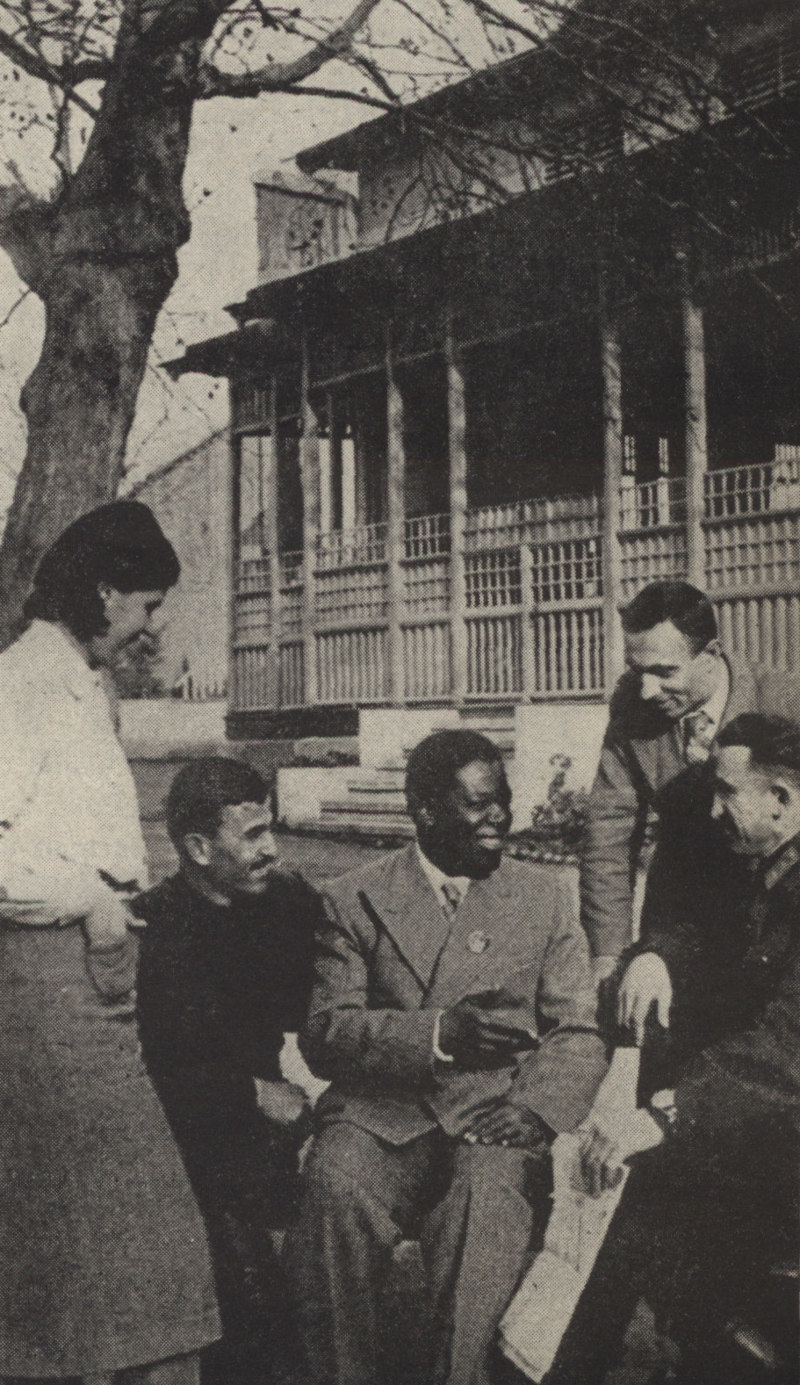
If one were to attend a meeting of the District Committee of the Communist Party at Tbilisi, capital of the Georgian Soviet Socialist Republic, one would notice among the delegates a powerfully built Negro, named Bashir Shambe. As is well known, to be a delegate to such an important committee is in itself a great distinction; for only persons of outstanding ability are elected to these responsible posts. Nevertheless, even among his fellow delegates Bashir Shambe is a man of special distinction. On his lapel glistens a government decoration, the badge of the Order of the Red Banner of Labor awarded by the Georgian Soviet Government. Such an honor is conferred only on those who have merited high marks of the gratitude of the people by exceptional achievement and devotion.
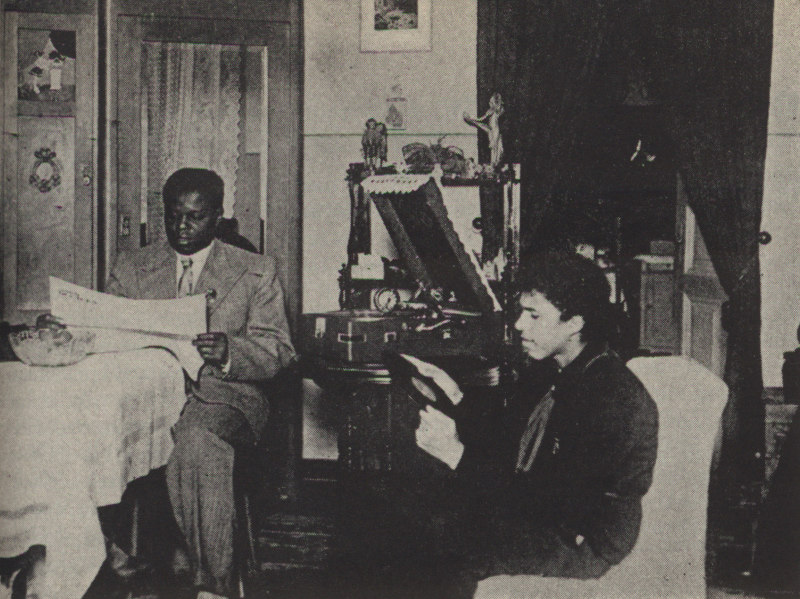
Following Bashir Shambe home one would note the respect and affection in the greetings received from his white neighbors in the apartment house where he lives. Walking in with him one would be introduced to Bashir Shambe’s Russian wife and his slender, handsome, mulatto son. The boy wears the tie of a Young Pioneer, in whose organization only the youth who show determination, devotion, intelligence and other high qualities can hold membership. From his alert, eager and confident manner one realizes that the son of Bashir Shambe has never known that Negro blood could be a bar to opportunity and to full participation in the life of the community.
If one stayed awhile and got Bashir Shambe to talk about himself—not an easy matter, for Bashir Shambe is a modest man—this is the story he would hear:
“I was born in Reheran, Iran (Persia). My earliest memories are of dust, smoke and filth, for my family were janitors and lived, as well as worked, in cellars.
“My parents came from Africa. They were Negro slaves. They had been purchased by agents of one of the Khans (nobility) of Teheran in one of the numerous slave markets in North Africa.
“On their arrival in Teheran and as soon as they were brought to the mansion of the Khan my father and mother, without being consulted in the matter, were immediately married, and immediately put to work.
“As Negro slaves the filthiest and hardest work was turned over to them without consideration of physical condition or previous type of work. My father was sent into the cellars and back alleys. My mother was sent to a tub in the kitchen to wash the mountains of dishes used in the lavish household of the Khan.
“My father had been made ill by the journey and arrived a sick man. But no attention was paid to his illness. He was compelled to work though his strength ebbed every day. Under these conditions he died after a few years of slavery in Teheran.
“My mother was left alone with four small children. I was the youngest. No consideration was paid her in her grief and bereavement. Her backbreaking work continued until the physical strain began to tell on her. Then her masters decided that she and her children were no longer worth keeping. She was thrown into the streets, with her four babies. That was how my family received ‘freedom.’
“To keep us alive my mother was obliged to hire out her children to masters who could find uses for the labor of children. They were hired on terms that were virtual slavery. I was still too small and weak to do any work and so I stayed with my mother. But not for long.
“As soon as I could move around enough to do errands I too was hired out, though it cost my mother tears and heartbreak to send me from her side.
“So at an age when I should have been playing with toys I began my life as a man on his own. Being on my own meant the meanest kind of drudgery. My life was full of indescribable suffering and humiliation.
“The gentry of Teheran amused themselves with gay parties. If a host noticed that one of his slaves or servants—there was little difference in their status—caught the fancy of one of his guests, it was the fashion for the host immediately to make a present of the human article to the guest.
“This custom was accompanied by another. The new owner was expected immediately to show the weight of his hand. This demonstration of the status of the master class was considered good etiquette and provided entertainment for the other guests.
“In time, this happened to me. Waiting on the guests of my master one of them spoke a few words to me. At this sign of favor the host decided that I must be presented to the man who had so honored me. This was done and my new owner gave me the ceremonial but thorough beating. Bruised from his blows I entered into my new life.
“My new master kept me in his service longer than any of my previous ones. At that time I had reached the ripe age of eight.
“My new master was what could be politely described as whimsical. He decided to make me serve as a clown to entertain him and his guests. He instructed me in Persian dances. And he trained me to grin, opening my mouth as widely as possible and exposing my teeth. To laugh at my white teeth, showing against my dark skin, seemed to him remarkable entertainment. To grin before him and his guests, whether or not I had anything to grin about, became one of my chief tasks.
“My only joy in those days was a meeting with my mother, whose sole joy it also was. But we rarely had the opportunity to have this pleasure. My mother passed from master to master. When she could get permission and time to see her children, most of the precious few hours had to be spent in merely finding where they now lived.
“Once after a meeting with my mother, I would not let her go. When she tried to send me back I refused and held on to her skirts. I clung to her to the very door of the mansion where she worked. My mother was frightened but she took the risk of taking me in with her. Since I was willing to do any kind of work I was allowed to stay.
“I remember this has the only happy period of my childhood. However hard the work was, I felt well paid merely to be able to be with my mother, with a human being who loved me. But this happiness did not last long.
“Tsarist troops were then quartered in Iran on one of the tsar’s imperialist ventures. One of the officers, a Georgian prince named Kimshiashvili, on his visits to Persian Khans, noticed the Negro slaves and servants, and decided to have one for his own retinue.
“Somehow it came to his ears that there was a Negro boy available of trainable age. He came to see me and he made my mother what was considered a large money offer for me. But it was not the money for which my mother let me go. It was for his promise to give me an education and to send me on a visit to her once a year, his estate in Georgia not being far from the border of Iran.
“The next day I was delivered to my new master. A few days later I was taken to Kazvin where the Russian troops were stationed. And not long afterward his detachment marched back to Russia. To heighten what he considered the comic effect produced by his Negro servant my master bought me a white donkey to travel on.
“My life in Georgia was no change from my life in Teheran. I was given a corner in the dragoon stables to live in. There I slept and ate. The promised education was forgotten together with the other promises. My mother and I never saw each other again. My work was menial and my Georgian master, like my Persian masters, used me as an object of sport.
“Then the Revolution came, but Georgia fell into the hands of the Mensheviks who held the country for three years. My master, Kimshiashvili, joined the Menshevik cavalry. As before he had me follow him on the white donkey.
“Finally the Mensheviks were defeated. Georgia became a Soviet Republic. If this meant real freedom and a new life for the Georgians you can imagine what a liberation it meant for me.
“To be accepted as an equal, to live as a human being and not as an object of sport for bored rich people—that was a dream fulfillment. You can understand with what eagerness I volunteered in the Red Army.
“My Red Army service was the happiest period of my life. I had comradeship, I had friendship, I had an opportunity to realize my capacities. I realized at last my own and my mother’s ambition. It was to see me educated that she let me go from her side. Now, though in a manner and with a completeness she never could have dreamed of, her hopes were fulfilled. I received an education, I learned to read and to write. I learned something of history, was able to understand something of the political and economic problems of my Soviet country and of the world.
“I also learned how to handle machinery for which I showed an aptitude. This was to lead me to my present work, that of a fire fighter. I am now a member of the Fire Department of Tbilisi.”
From Bashir Shambe’s associates one can supplement the story he left in modest outline. Shambe joined the Young Communist League in 1923. His abilities speedily brought him to the leading position in the local organization, that of Secretary. Soon after he was elected to the Tbilisi Soviet.
In 1928 he was admitted to the Communist Party and had soon risen to leading positions. The recent government award he received was a popular event in Tbilisi. Tbilisi, the capital of the Georgian Soviet Republic, and historic center of a proud people, counts the Negro Bashir Shambe as one of its most distinguished citizens.