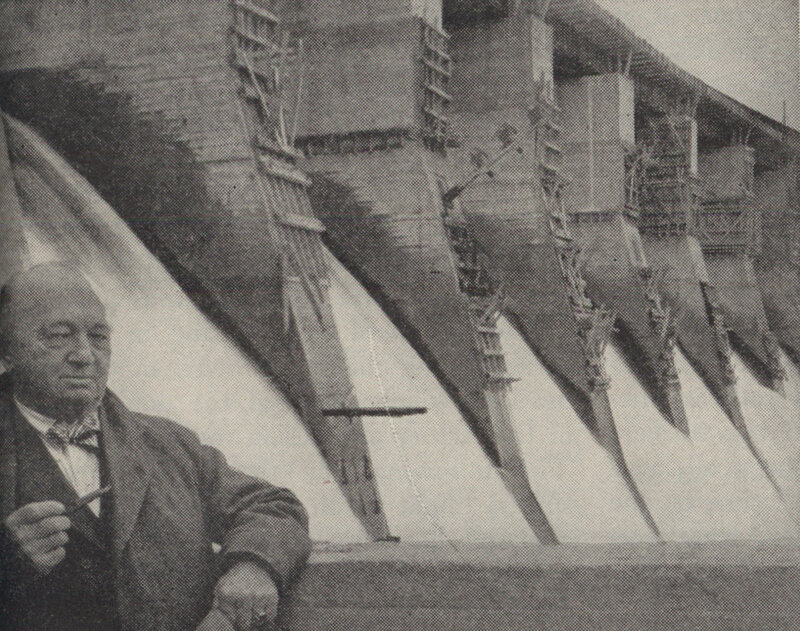


On the dauntless spirit with which the civilian folk of Russia have taken on the task of the present World War
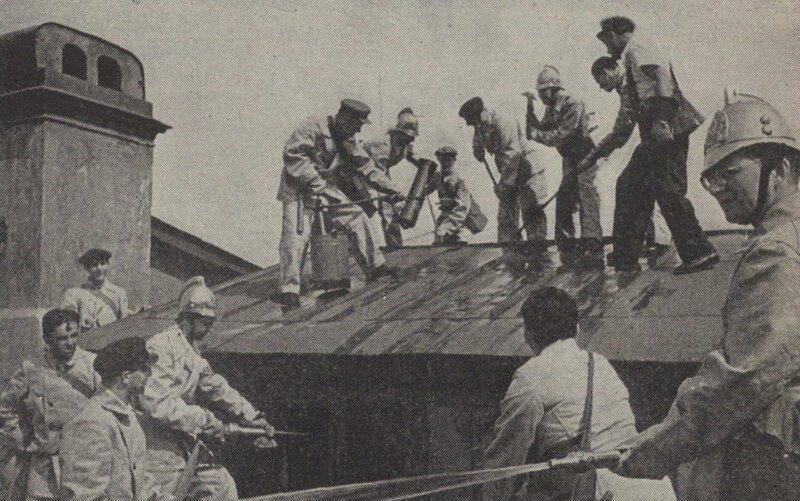
There are no “non-participating civilians” in wartime Russia. Men, women and children have their part in the total defense plan which needs the capacities of architects, musicians, housewives, factory workers as well as of soldiers.
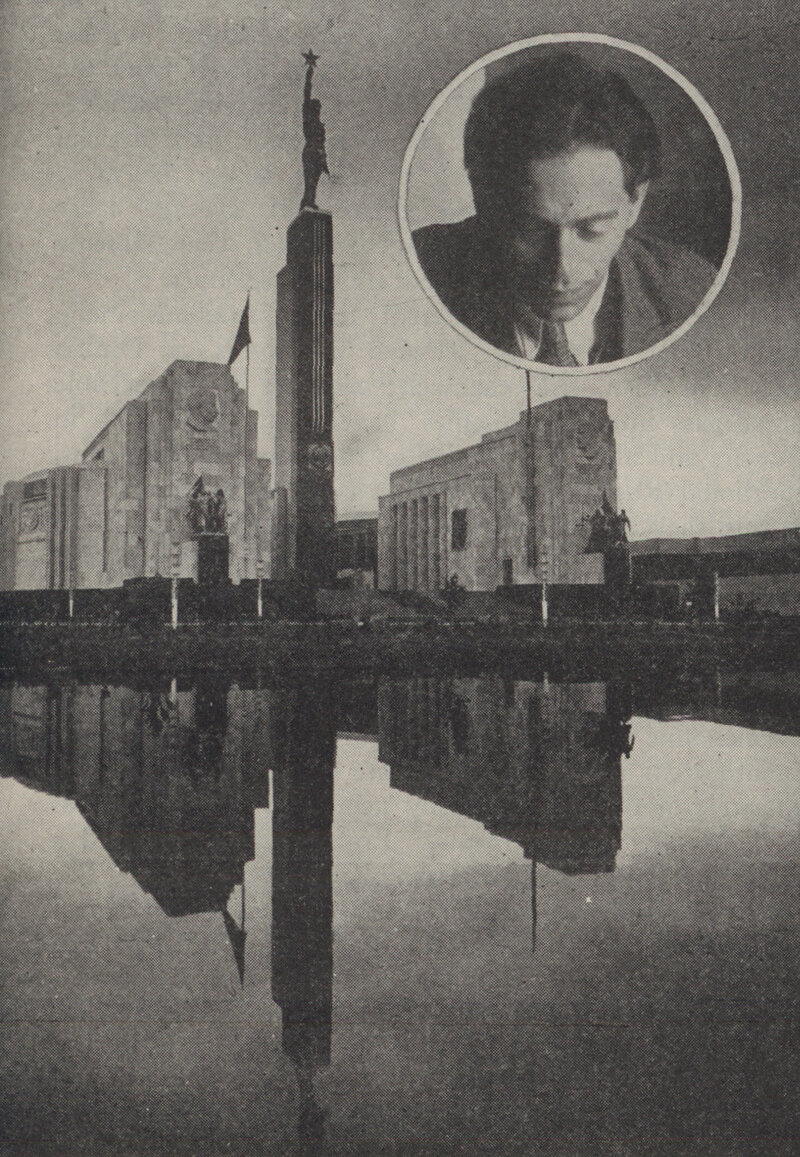
Take Boris Yofan, the famous Soviet architect. He is known to Europeans as designer of the Soviet Pavilion in the great Paris Exposition and to Americans as architect of the Soviet Pavilion at the 1939 World’s Fair. This gorgeous structure of polished marble topped by a heroic steel statue of a Russian worker, on a red and white marble shaft two hundred and sixty feet in the air, created a sensation among the lath and plaster structures of other exposition buildings. But Yofan’s chief fame among the Russian people is that of co-designer of the great Palace of Soviets, now for several years under construction, which will be, when completed the world’s largest parliament hall, seating twenty thousand people, and also, with the giant statue of Lenin on top of it, the tallest structure in the world.
Last June, when the Germans invaded Russia, Yofan was busy with two projects. The towering steel shafts were beginning to rise above the tremendous foundation of his Palace of Soviets. Meanwhile, in the spacious grounds of the Moscow Agricultural Exposition the Pavilion from the New York World’s Fair was being re-erected as a permanent structure; block by block it had been taken down, each piece of marble checked out through the New York customs and shipped back to Moscow across a world at war. But Yofan turned at once from these two great projects and offered his services to the Red Army.
What has an architect to do with an army? Plenty, it seems. Yofan’s first job was the camouflaging of the city of Moscow, a task which fully used his daring sense of perspective. He was accustomed to creating giant figures on tops of buildings whose proportions would seem natural when viewed from far below; now he produced strange shapes in the Soviet landscape which changed great factories into farms and forests when viewed from far above. The German air bombing of Moscow was strikingly ineffective. This was due both to excellent air defense and to the correlation of thousands of details like the camouflaging of Boris Yofan.
After camouflaging Moscow Yofan helped build fortifications; here his brilliant knowledge of stresses and strains in reinforced concrete came into play. In those desperate days of last October, when German tanks crushed Moscow’s outer defenses and when most foreign military experts expected the city to fall, all able-bodied civilians of Moscow took to the fields to do their bit. Mrs. Ivy Litvinov, wife of the Soviet Ambassador to Washington, told me that her children were among the tens of thousands of university students who spent three weeks camping fifty miles out from Moscow and digging ditches sixteen hours a day. Yofan and other architects helped plan this digging for maximum effectiveness. The entire landscape in front of Moscow was covered with tank traps, barricades of concrete, iron rails crisscrossed and embedded deep in the highways. Due to these excellent fortifications, and their effective use by the Red Army, the Germans were held and driven back from the capital.
In November and December Boris Yofan and other architects moved out to the Volga and the Urals where they designed the rapidly rising new industrial plants. One of the chief features of Russian strategy was the march of the factories out of the invasion-threatened areas to the safer cities of the east. It was the most stupendous evacuation of industry in history, on a size only possible in a country with state-owned industry. It was part of the strategy which saw to it that the German invaders should not acquire a going concern as they had elsewhere, but ruined cities and ravaged fields.
Factory workers gave to moving their factories the same twenty-four hour a day devotion that is expected of soldiers in active war. They formed gangs to dismantle machinery, take down door and window frames, grease, pack and load parts. The whole of the Leningrad carburetor plant, for instance, was loaded on flat cars and all machines were carefully covered with tarpaulin. It went east by fast freight, carefully guarded on its journey by its workers, engineers and their families who traveled in box cars on the same train. They assembled the plant in record time in a large city on the Volga. Thousands of other factories similarly traveled; every correspondent in Russia in those months mentioned these factories on the march. Their swift reerection in adequate buildings depended on night and day labor by Russian architects like Boris Yofan. Other architects made designs for mass production of housing for their millions of refugees who fled eastward before the German advance.
“We must build better and more beautifully than before,” he says. “We must eliminate the old distinction between the smoky, congested city and the isolated countryside. Our towns must give efficient transportation and pleasant living over their entire area with adequate open spaces and recreation parks. Our rural districts must be so grouped as to have modern utilities, water, gas, electricity, telephones, central heating and well-equipped schools, hospitals, libraries and theaters—in short—the recreational resources of city life.”
It is an amazing vision for a people still struggling with the nightmares of German occupation over a large area of their land. But there are good chances of its coming true. For Boris Yofan is only one of millions of Russian civilians—artists, writers, engineers, doctors, scientists—whose talents have been harnessed to the detailed needs of war and of reconstruction after war.
The Ukrainian Academy of Sciences, for instance, was evacuated at the outset of the war into the deep hinterland beyond the Volga, and has recently held a session which summed up six months’ work. Over eighty papers were read on various subjects, and, while many of them dealt with matters that are still military secrets, enough has reached me to show that in a score of different branches the Ukrainian scientists have been energetically assisting the tasks of war. Mathematicians have been elaborating the complicated mathematical calculations on which steady improvement of the Soviet airplanes is based. Numerous parties of Soviet geologists are prospecting for rare minerals needed for defense and which cannot now be imported. The Chemical Institute of the Ukraine has been evolving new kinds of industrial raw materials. The Botanical Institute has been experiments which will substantially increase the country’s yield of grain.
Adequate rubber supply has been one of Russia’s problems as it is of Britain and the United States. The Russians however have long since developed a good quality of natural rubber from wild bushes growing in the arid plains of Soviet Central Asia. The most notable of these is the Kok-Sagyz plant. In the past six months Dr. Vlasuk, working under the Ukrainian Academy of Sciences, has found methods of increasing the rubber content of this strategic plant by at least twenty-five per cent. Other scientists have been perfecting methods of producting vitamins and applying these to the difficult problems of nourishment in the war-ravaged land. The Department of Biological Sciences has worked out new methods of treating wound infections. The Institute of Clinical Physiology has evolved a serum which is now being used in the military hospitals to accelerate the healing of wounds. These are only a few of the achievements of one particular group of scientists—the Ukrainian Academy—which was rescued from Kiev before it fell.
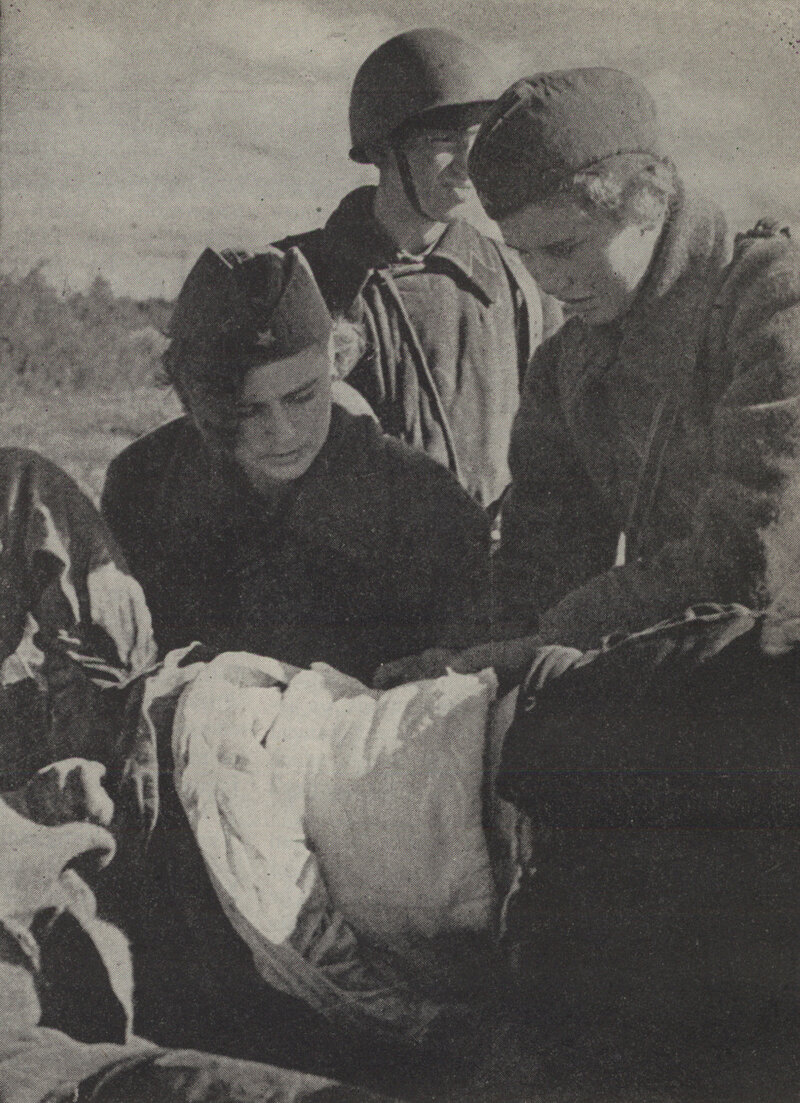
In all countries the branches of science dealing with surgery and medicine are strongly simulated by the needs of war. Russian doctors have carried their efforts much closer to the actual front than has been common in other wars. Airplanes attached to the medical services evacuated the heavily wounded directly from the field of battle. Nurses go on the field itself, give first aid treatment and carry off the wounded under fire. The deaths of doctors and nurses in this war have been greater than ordinary. But the proportion of death among wounded soldiers is only 1.04 per hundred, a remarkably low figure especially in a winter campaign.
Practically no deaths occur in the Russian army from tetanus; every soldier is vaccinated against it before going to the front. Up to December 15 no contagious disease was reported in the Russian army. At this time the German army was suffering severely from typhus, a louse-borne blood disease which spreads when conditions of filthy living in trenches condemn the soldiers to infestation with countless lice. The Russians had practically none of it. One reason for this was the Russians had much better bases, close to warm cities where bathing was easy. One of the specific causes for the freedom of the Russians from typhus was their famous “Bath Train.”
The idea of the “Nine Car Bath Train” was originated by railway workers in the repair shops of the Moscow-Leningrad Railway. It spread like wildfire to the other railway lines of the country and soon the workers in the railway repair shops all over the land, though busy full time on the regular work of the war, were volunteering to work out of hours to present bath trains to the front. Each bath train was sent with a gaudy inscription along its sides mentioning the railway shops from which it came.
The bath train furnishes a large public bath on wheels which travels to the most distant parts of the front, and gives baths on a sort of conveyor plan. The man pour into the first car to take off their clothing. The linen is sent to a laundry car while coats and jackets go to a disinfecting car at the far end of the train. The men themselves without clothing pass into the second car for hot showers and all the attractions of the traditional Russian steam bath. From this they go to a dressing car to receive fresh linen. While waiting for their outer clothing to be disinfected they rest in a couple of club cars where they read papers, play chess or amuse themselves on the baby grand piano with which one of the cars is equipped. In another car in the train are the living quarters of the train’s own personnel.
The German-Soviet war is not only a war of men and machines; it is a clash of two different cultures. The invading Nazis have expended a peculiar ferocity in attempts to stamp out the heritage of Russian culture. They looted the beautiful Tolstoy Museum in Yasnaya Polyana and burned the greater part of it, saying to the Museum’s attendants, “We will destroy every relic of your Tolstoy.” They destroyed the Tschaikovsky house in Klin and wantonly burned his manuscript music. In Taganrog they burned the home of Anton Chekhov and cut down his famous cherry trees. It was a rage to destroy all symbols of a culture which successfully defied the Nazis’ claim to supremacy.
The Russian people, on the other hand, determined that even in wartime their art, music, literature—that culture which is the soul of Russia—should not suffer but should be expanded as a mighty weapon in war. The whole Soviet countryside blossomed with war posters of remarkably good artistic design. They were the work of the best of the Soviet painters. Other painters journeyed to the front and at considerable risk depicted battle scenes for future historical museums.
Famous opera singers sang in factories during the lunch hour, in celebrations which recorded the doubling of the factory production for the front. The following day the same opera singers might be on duty in a hospital applying bandages. On the lapel of one such singer’s coat was a government decoration indicating that she was a “People’s Artist”; alongside of it was her Red Cross badge. No less than thirty groups of artists from the Moscow Theaters are giving performances for the Red Army; half of them have been traveling along the front while the other half average forty performances daily for the Moscow garrison and air defense units.
Undoubtedly the most famous among living Russian composers is Dmitri Shostakovich; many of his remarkable symphonies have been performed in Europe and on the American continent. He did his bit as an air warden in the besieged city of Leningrad and often risked his life going with musical groups to entertain the fighters on the front. During the siege he found time to write his Seventh Symphony, dedicated to “the heroic common people” in war and victory. The composer Gliere wrote an overture for a symphony using the Slav people as his theme. Prof. Gedike composed a dramatic symphonic overture on “The Year 1941” while the composer Koval wrote an oratorio entitled “The People’s Sacred War.” The best composers, including Shostakovich, also wrote popular war songs for the front.
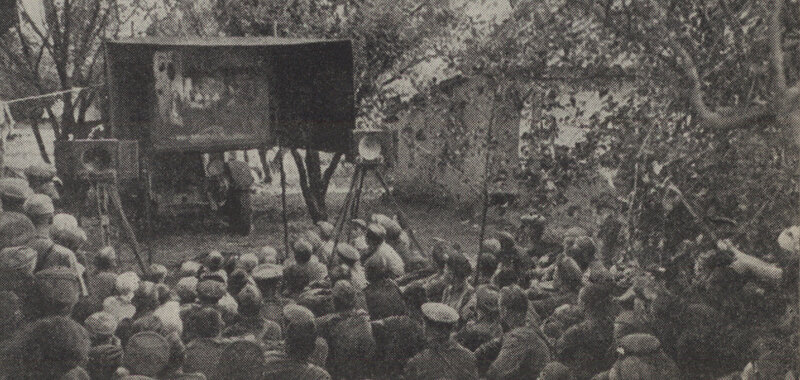
From the beginning of the war the Russians stressed the world-wide nature of the conflict and promoted an understanding of their allies. Newsreels showing the heroic defense of London were as widely cheered in the motion picture theaters as were the exploits of the Red Army itself. At the end of November, in the midst of the final and most dangerous German assault on Moscow, when the thunder of enemy guns was constantly heard, a great exposition of American writers opened in Moscow showing the works, photographs, rare editions, translations of the whole history of American literature, beginning with Benjamin Franklin, Washington Irving, Ralph Waldo Emerson and ending with John Steinbeck, Upton Sinclair, Clifford Odets and Pearl Buck. Over the entrance to the exhibition was the inscription “Long live the USA which supports Great Britain, the USSR and other freedom-loving peoples in their just war against German fascist aggression.” This was before the United States actually entered the war.
When the tide of battle turned back from Moscow Russian citizens of all professions took on the task of reconstruction with the same united zeal. Countless repair gangs moved westward from Moscow, following the Red Army in the winter storms. Telegraph linemen set up communications; following these came the railway repair crews. Squads of Moscow building workers poured into the newly liberated towns and villages to repair the power stations, water mains and local industrial enterprises. Collective farmers in the uninvaded districts sent seed for the spring sowing to the farms that had been destroyed. Workers in factories far in the Urals collected clothing and household goods for the devastated regions. The musicians and composers of Moscow took on the job of restoring the Tschaikovsky home in Klin. A committee from the Academy of Sciences inspected the Tolstoy estate at Yasnaya Polyana and announced that it would restore and reopen the famous museum by May 1st.
Such is the dauntless spirit with which the civilian folk of Russia have taken on the task of the present world war. Never once have they lost full confidence in ultimate victory. On a cold gray dawn last autumn as the Red Army was retreating from the Dnieper the morning quiet was broken by a terrific roar. People looked at each other and tears came as they knew that the great Dnieper Dam was blown up. They loved that dam, first child of the Five Year Plan, first bringer of light and power to a backward peasant area. People stared for several minutes toward the direction where the waters of the river were rushing through the breach.
“Never mind,” said someone finally. “We will build a new one and we will build it faster and better. The experience and confidence of the people is the main thing that counts.”