



In the second article of her series the author describes the organization, methods and curricula of Soviet schools
The Russian word for education is prosveshchenie— “enlightenment.” The root of the word is svet meaning “light.” In pedagogical literature this word is usually accompanied by two other words: vospitanie, “up-bringing,” from the verb pitat meaning to “nourish, feed, foster,” and obrazovanie, “to form,” from the root obraz meaning “form, shape.”
These three words give an accurate picture of what Soviet education aims at: the fostering care of the younger generation, enlightening them as to the world about them, their place in it, its influence over them and their influence over it, what the human race has so far accomplished in attaining freedom and power over its environment, and so forming them that they will have the ability, knowledge, power and desire intelligently and persistently to carry forward this work in their turn.
This is what is meant by “communist education.”
Every activity of the Soviet state has this as its aim. Every state farm, collective farm, every factory, every institution—even those for the mentally deranged and the socially unfit (prisons)—is thus an educational institution. Not incidentally, as life itself may in a broad sense be called “educational,” but intentionally, with planned educational activities.
In writing about education in the Soviet Union one must, therefore, state what particular branch of Soviet education one is going to discuss. This article deals specifically with the schools.
Organization
The Central Planning Commission, which plans the economy for the whole union, has a social-cultural section. This section plans the education for the whole USSR—the number of new schools to be built, the kind of schools, whether primary, secondary or higher institutions; how many pupils are to be cared for, and up to what grades and in what localities education shall be compulsory, etc. This department also sets the sum to be allotted from the central treasury to each republic for education.
The executors of this plan are the Commissariats of Education of the several republics. The Commissariat of Education of the RSFSR is the most influential of all commissariats, and in practice, it is almost the same as a federal commissariat, so uniformly are its practices adopted by the other commissariats. However, it has not the power to enforce its program and there are variations in the different republics, due to the Soviet policy of fostering national culture and respecting special national problems.
The head of the Commissariat of Education, in Russian Narkompros, (compound abbreviation of three Russian words meaning “People’s Commissariat of Education”), is appointed by the Central Executive Committee of the Supreme Soviet of the republics. He is assisted by two vice-commissars.
The Commissariat of Education is divided into various sub-departments. There are sub-departments for the various grades, as follows: pre-school, for children four to eight, (previous to that children are under the care of the Commissariat of Health); elementary, for those from eight up to the age of twelve; incomplete secondary, for those from twelve to fifteen; complete secondary, for those from fifteen to eighteen. There are also sub-departments for higher education, (technical colleges, universities) and for technicums (corresponding to technical high schools) and normal schools. Then there are departments in charge of theaters, moving pictures, publications. There is also a separate department for adult education.
Working with the Commissariat is an advisory committee of experts in different fields.
The Commissariats of Education have authority over the issues of text-books, and decide upon curricula, length of school year, and such questions.
Under the Republic Commissariats of Education are the regional, district and local Educational Departments, appointed by their respective Central Executive Committees. These have authority over such matters as concern the given region, district, or locality, i.e., school equipment, buildings and appointment of teachers.
The principal of a school, whose title is director, is appointed by the local Educational Department. Teachers are appointed by the director of the school with the approval of the local Educational Department. The director is responsible for the administration of the school and is accountable to the local Educational Department, to the School Council (made up of teachers), and to the local Parents’ Council, which works closely with the School Council. Great importance is attached to the necessity for cooperation between the school and the home.
The Commissariat of Education finances teachers’ salaries and school equipment. In practice, financial aid comes from other sources also. Trade unions, cooperative societies, and parents’ associations contribute to school building, equipment, and upkeep.
Until recently no tuition was charged in any school beyond the pre-school. Tuition, graded according to income of the family, has always been charged in nursery schools and kindergartens. But, in October, 1940, the decree establishing new, free vocational schools for the training of a reserve labor force, provided that: “The rise in the living standards of the people and the rise in educational expenditures on the part of the Soviet State made it necessary that part of the expenses of tuition in secondary schools and higher educational institutions should be borne by the working people themselves.” Accordingly, except for “A” students, that is, students whose grades are at least two-thirds “A” and one-third “B,” who cannot afford to pay for tuition, students in the 8th, 9th, and 10th grades of the secondary school pay 200 rubles a year in Moscow, Leningrad, and the republic capitals, 150 rubles per year elsewhere. In higher educational institutions, the tuition is 400 and 300 rubles, respectively. Students of art, drama, music, etc. pay 500 rubles per year. Correspondence courses are half this rate.
By the same decree stipends for students in the secondary and higher institutions were limited to students distinguished by their ability and devotion to work. Here “A” students will still receive stipends and, in case of need, free tuition.
It is expected that this change together with the simultaneous opening of the free vocational schools will tend to stimulate higher scholarship standards and encourage participation in industry, where there is a serious need for more trained personnel, (and where further educational opportunities are provided), by those less suited for an academic career.
The Schools
Nursery schools and kindergartens provide for the care and training of children up to the age of eight years.
Beyond that age come ten years of school, divided into: elementary, four years; incomplete secondary, three years; complete secondary, three years. Upon finishing the complete secondary school students go, according to their inclinations and ability and with the advice of counselors, either to a higher technical institution (VTUZ) or a university (VUZ). There is also the wide network of technicums which provide a four-year course, including general education and specialized training, for students who have completed the seven-year school. During the regular ten years of schooling there are frequent vocational tests so that by the time the ten-year school is finished pupils have had a good chance to find out where their interests and abilities lie. Only those with good records of scholarship and conscientious interest in their work are admitted to the higher institutions. The others can find useful and suitable work in active productive work and if, later, they find they need to return to higher schools for further education, they are able to do so at any time.
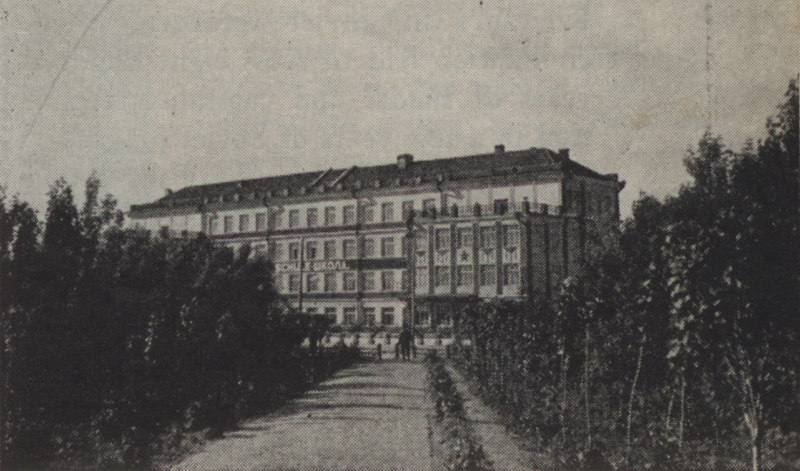
Schools open in September, with great fanfare. The opening day of school is celebrated by fetes and parades all over the city and the entire population joins in rejoicing with the children that their schools are again opening to receive them. Special performances are given in theaters and moving picture houses for them, special programs planned in theh parks of culture and rest. Like most European schools, work begins at eight in the morning. There are still some schools which have to run on two shifts, but it is not intended to keep up this practice and schools are being built at a rapid rate. The intention is that for the child the school shall be the place where he spends most of his waking day, where he finds both work and recreation. Due to the fact that there are so many extra-curricular activities, it is not unusual for children to leave home shortly before eight in the morning and not return again until about six in the evening. Hot meals are provided in the school restaurants, for which a small fee is charged where the family income can stand it, otherwise either the parents trade-union bears the expense or the school makes no charge. The latter is, however, exceptional as, since there are jobs for everyone in the Soviet Union, most parents are quite able to pay for these meals.
The school year consists of 196 days, with a spring, fall, and winter vacation. The activities planned for school children during vacations will be discussed later on. The school day in elementary schools is divided into four periods of 45 minutes each, with three recess periods, one of ten minutes during the morning, a luncheon period of 30 minutes about 11 o’clock, and two recesses of ten minutes each during the afternoon session. In large schools these recess periods have to be staggered so all the children can be accommodated in the school dining room without crowding. Such studies as language and arithmetic, which require more intensive concentration, are given during the earlier periods. Drawing, singing, and physical culture come in the later hours of the day when the children are more likely to be tired and less able to concentrate.
The following table gives the distribution of the hours for elementary schools:
| Grade | ||||
|---|---|---|---|---|
| Subject | I | II | III | IV |
| Russian Language | 10 | 10 | 8/6 | 7 |
| Arithmetic | 5 | 5 | 5 | 6 |
| Science (nature study) | — | — | 2 | 2 |
| History | — | — | 2 | 2 |
| Geography | — | — | 2 | 2 |
| Writing | 2 | 2 | — | — |
| Drawing | 1 | 1 | 1 | 1 |
| Singing | 1 | 1 | 1 | 1 |
| Physical Culture | 1 | 1 | 1 | 1 |
| 20 | 20 | 20 | 20 | |
Note that in the fourth year two extra periods per week are given. These two periods are devoted to drawing, singing, and physical culture. There is a slight difference in the program of country schools which have a total of 3,202 hours for the four grades in the school year as compared with 3,215 for city schools.
Methods
Reading is taught analytically. First a word is pronounced orally, then broken down, still orally, into its syllables, which are in turn broken down into their letters. Only after this oral analysis is thew ord printed and written. The child learns to read both printing and script simultaneously. Spelling and grammar are not taught as separate subjects but are gradually introduced into the language study as an integral part of it. In the first and second years before science is begun as a formal study, nature study taught along with language work. But reading must always be accompanied by direct acquaintance with the object read about. This is done through excursions into the country, observation of animals and growing things in the school plot and gardens, etc.
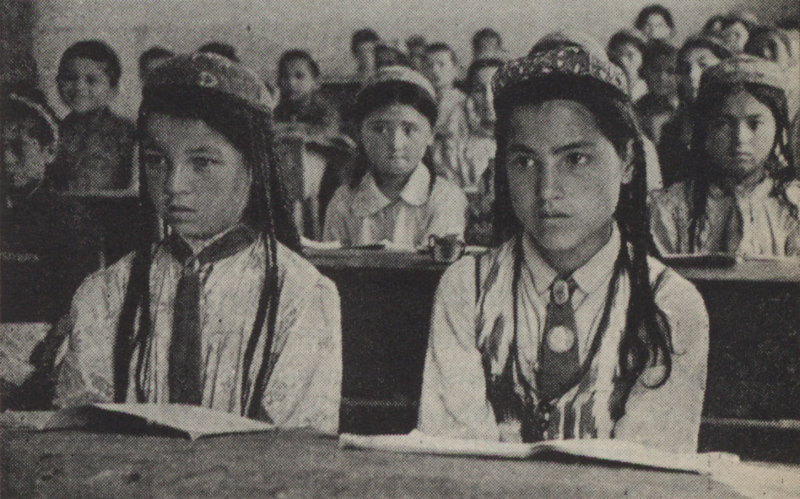
The political slant is not stressed at all during these first two years. Of course, there are the celebrations on the national holidays which have a political content, and there are often political angles to the plays and movies for children, but their attention is not called especially to this subject until later when the study of history and geography begins, during the last two years of the elementary school when the children are from ten to twelve years old. In addition to the regular reading books supplementary reading is not only advised, a certain minimum is required, and the children are trained from the beginning of this supplementary reading to understand and discuss the content of the books they read. As soon as they are able to do so they keep note books in which they list the books they read, give something about the life and times of the authors, summarize the contents of the book and end by telling why they either liked or disliked the book.
Literature
Among the authors listed for supplementary reading during the elementary grades are: Hans Christian Andersen, (all the fairy tales), Grimm’s Tales, selected stories from Victor Hugo, Perrault’s fairy tales, Defoe’s “Robinson Crusoe,” Kipling’s “Rikki-Tikki Tavi” and the Mowgli stories, Jack London’s “The Wolf” and some other similar stories of adventure and animal life, “Adventures of Baron Munchausen,” Swift’s “Gulliver’s Travels,” several books by Ernest Seton-Thompson on wild life, Mark Twain’s “Tom Sawyer” and “Huckleberry Finn” (prime favorites in the Soviet Union, published in editions of half a million and never enough to supply the demand), Jules Verne, who has always been the favorite author of both pre-revolutionary and post-revolutionary Russian children. Of Russian classics Pushkin, Nekrassov, Lermontov and even one poem of Tiouchev are recommended. Pushkin’s fairy tales are stressed, and, of course, the fables of Krylov, which are learned by heart as French children learn their LaFontaine. Besides Pushkin’s tales, and some of his poems with beautiful descriptions of nature, his story about the Pugachev rebellion, “The Captain’s Daughter,” is on the list. In prose, stories by Tolstoy, Gorky, Turgeniev are included. There is even one story by the famous French writer Ouida on the list. There are many more classical authors included than Soviet writers. The latter are represented, among others, by: Marshak, Ilyin, Mayakovsky (who wrote the famous poem “To Children”), Chukovsky, Gaidar, Kassil, Bianki… Ilyin has more titles on the list than any other Soviet writer. He has been called the “Father of Children’s Literature.” In American schools, too, Ilyin’s books about science are found in many school libraries.
Science
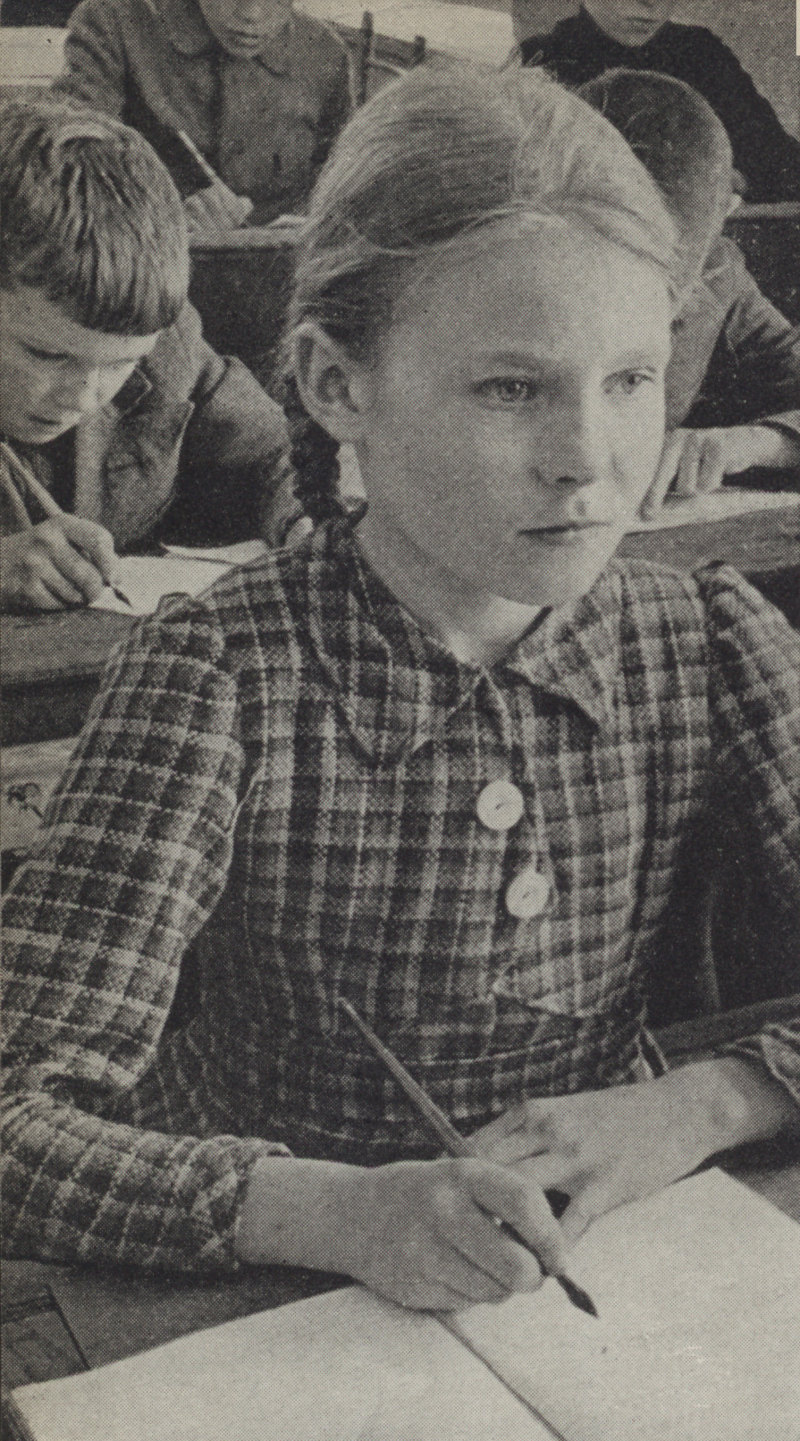
In the third and fourth years two periods per week are given to science. The aim is not only to familiarize the child with some of the more fundamental principles but also to introduce him to laboratory work and get him used to performing simple experiments himself and to making and recording observations, since the study of science is going to make up a large part of his school work in the next six years. During these first two years the work is concentrated on the study of soil (including rocks, soil erosion, and such things, thus introducing him to the study of geology), water, air, electricity, and anatomy and physiology of animals of the neighborhood, as well as general study of the life habits of animals and birds, etc. In physiology application is made to care of their own bodies and measures for protection of the children’s health and the health of the community. Simple experiments are made in a laboratory, such as expanding water with heat, finally turning it into steam, and reconverting the steam by letting it settle on the sides of some cold body, and on the elasticity of steam and air. The experiment to demonstrate the latter is to make a popgun. Visits are made to gullies and ditches in the neighborhood to observe the effects of erosion, and samples of various soils and rocks are brought into the laboratory and studied. This nature work is mainly directed to study of the immediate neighborhood. Excursions are a regular part of the school work and collections are made of specimens of harmful and beneficial insects. The making of herbaria to show the developments of plants from the seed to the flowering and fruiting time is required work. This work is closely linked up with the regional museums which are distributed throughout the whole Soviet Union, which both teach the local inhabitants the known facts about the section of the country where they live, and carry on an intensive study of local history and resources.
The study of electricity begins with observations of thunder and lightning storms, getting small electric charges by friction and other simple electrical experiments. In zoology and physiology skeletons of animals of the neighborhood are studied and compared with one another and with a human skeleton, etc. Films and magic lantern projections are used, where possible, to aid in a fuller understanding of life than it is possible for them to get at first hand at this early age.
History and Other Studies
Especial emphasis is laid on the proper presentation and study of history. It is begun as a formal study in the third and continued in the fourth years of the elementary school. Only the history of their own country is studied during this time. It is divided into two parts: first, from 911 to the second half of the 17th century; second, from Peter the Great to the present time. In teaching the history of the past of Russia the aim is not merely to acquaint the pupils with the bare facts and dates, but by means of contemporary literature, pictures, moving pictures and so on to impart a vivid realization of what life was like in those old days when peasants were bitterly exploited serfs, half starved, beaten, killed even by their lords; to bring alive the heroic struggles of those earlier days, the fierce fights of the workers behind the barricades in Moscow and other cities during the revolution of 1905; and to make a part of the children’s own experience the joy of the delegates to the Second Congress of Soviets on October 25, 1917, when Lenin announced the successful victory of the socialist revolution.
The text-book used for teaching the History of the USSR, from 1917 to the present time, is by Professor Shestakov, and was prepared under the direct supervisions of the Central Committee of the Communist Party of the Soviet Union. Here for the first time scientific communism, Marxism-Leninism-Stalinism, is formally studied, and the foundations of theoretical education are laid.
Geography is also regarded as one of the most important studies during the third and fourth years. The aim is to make the child familiar with the map of the world, special attention being given to the cartography, physical geography, and, naturally to the political and economic geography of the Soviet Union. The Soviet Union, as a whole, and each republic in particular, are studied with a view not only to learning rivers, cities, boundaries, but in order to learn what the possible resources of the country are, how far they have been exploited and what tasks lie ahead when these children have taken their places in the working world of their parents and older relatives. This idea is constantly kept before all school children, that they are in the future going to take the places of those workers now engaged in production, and hence their job for the moment is to prepare themselves for the intelligent, honorable and glorious fulfilment of their tasks as Soviet citizens.
Also, “Geography, properly taught, can be a potent means of inculcating communist principles. It helps the child to a correct understanding of the nationalities policy of Lenin and Stalin (when he studies about the life in the various national republics), makes them ardent patriots of the USSR and prepares them to take an active part in the work of socialist construction.” (From introduction to the decree of May 16, 1934, on the teaching of geography in elementary and intermediate schools.)
Arithmetic is taught every day during the whole four years. Complete mastery of the four fundamental processes is required. During the last year fractions and decimals, the metric system, percentage and some elementary geometry are studied. The main principle of instruction in this field is: “Never go on to the next step until the preceding step is thoroughly mastered.”
Drawing, music, and physical culture have each an hour per week during the entire four yearse in the regular curriculum. But much more time is spent on them through the many circles to which an article will be devoted later. Visitors to Soviet schools are invariably delighted with the uniformly excellent and spontaneous drawing, singing and dancing of Soviet children.
Discipline
Discipline rests finally with the classroom teacher. But every class has a committee of pupils who actually assume most of the responsibility for the behavior of the class. This committee has regular meetings, some with the teacher, and takes up and decides on all questions of class-room discipline.
When a teacher or a visitor enters a class room the children stand respectfully, sitting down again when the visitor is seated. Recitations are carried on in about the same way as in American schools. The atmosphere, while perhaps freer, is much the same as that in an American class room. This writer once heard Pinkevich, a leading pedagogical authority, giving a lecture in Moscow University on his observations of class room relations between teacher and pupil in foreign countries, and he expressed himself as very pleased with the cordial, easy, friendly relationship he found in American class rooms, in contrast to what he had observed in France, England and Germany.
This writer, who has been a teacher in American schools, was impressed with the difference in outlook of Soviet children from ten to twelve, as compared with American children. Universally they knew why they were studying each particular subject, and were filled with the same enthusiasm for their studies that adult Soviet citizens display in connection with their work.
In the USSR pupils raise their hands to ask permission to move about or leave the room, and to call the teacher’s attention to the fact that they are prepared to answer a question which some one else is failing to answer.
There are examinations and marks, graded from failure to exceptional. These marks are no different from the marks used in American schools to grade the work of pupils. But they are quite different in their significance. Rivalry between individuals is rare. Rivalry is there, but it is of a collective rather than an individual nature—between two different sides of the room, between different classes in the school, between one school and another. So the abler pupils are always trying to help the slower ones along to raise the class average and outdistance their challenger or the group, class, or school they have challenged through what is known as “socialist competition,” which has become familiar in all phases of Soviet life.
The reader will have noticed that no mention has been made in the program of “manual training” or “domestic science.” And it is a fact that these subjects are not on the program of Soviet schools. The educational authorities reason that in the present highly mechanized age it is not good practice to teach the child to produce commodities in out-moded ways.
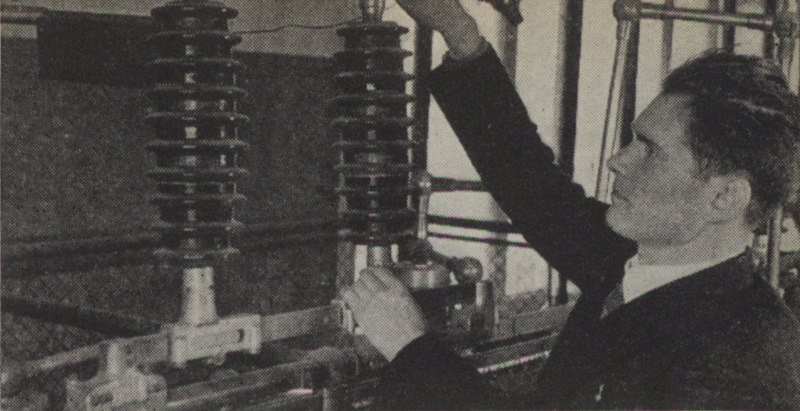
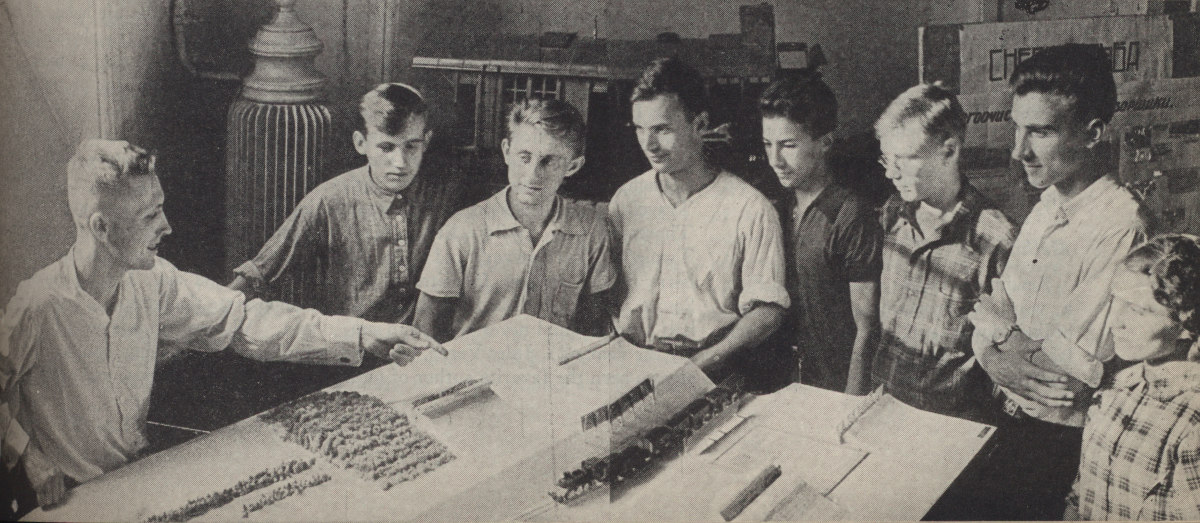
This does not mean that children are not trained to construct and build with their own hands. Such work is carried on outside the class room in “technical centers,” provided with modern machinery and under the directions of specialists in the particular kind of work done in them. Here children make all kinds of things—toys, airplanes, parachutes, machines, etc.
There are many, many other extracurricular activities. No child this writer interviewed but was a member of one or more of these “circles”; dramatic circles, literary circles, aeronautic circles, military circles, art circles, music circles…. All these circles are in close touch with work going on in their specialty in actual life outside the school. The Dramatic Circle of the Twenty-Fifth of October school in Moscow is under the special patronage of the First Moscow Children’s Theater. The members of the circle meet with actors and producers of the plays given and help with criticism and advice in the actual carrying on of the work of the theater. The staff of the theater, on the other hand, gives actual help in planning and carrying out of ddramatic productions in the school.
(The next article will deal with the program of the secondary schools.)