

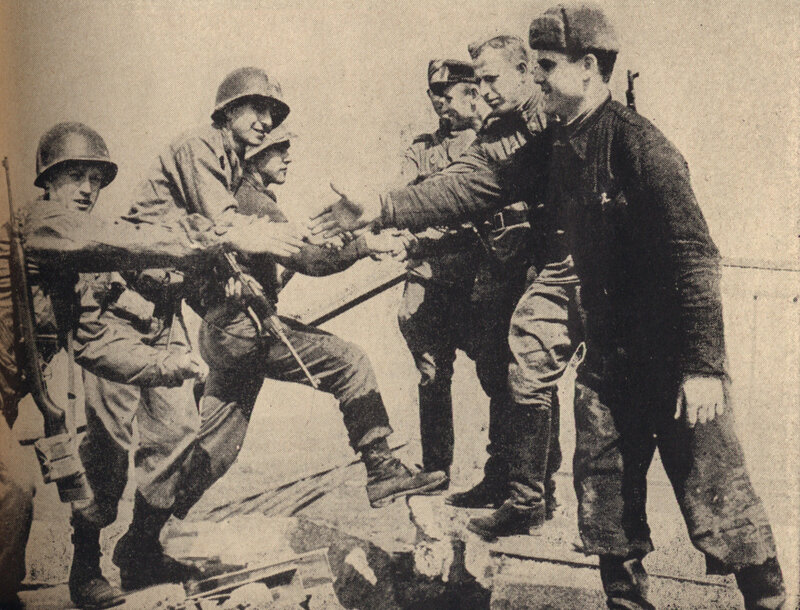
A composite picture of the mighty Red Army offensive that crumbled the Nazi citadel.
The fall of Berlin, mighty fortified heart of Nazi Germany taken by Marshals Zhukov and Konev in ten days of assault, will go down in military history for future generations to admire and study. Fortunately, Soviet writers, aware of their greatest opportunity, covered the Battle of Berlin as nothing else had ever been covered from the Soviet Union. Events were reported in many areas and from many angles.
It is therefore possible, the day after the fall of Berlin, to compile a composite picture. Moreover, I personally was in Poland during the preceding drive from the Vistula to the Oder which established the bridgeheads needed for the final storming of the Nazi capital. From scores of American prisoners of war liberated by the Red Army, who had an unexampled chance to see it in action, I took down the most vivid details of the methods and logistics of this advance.
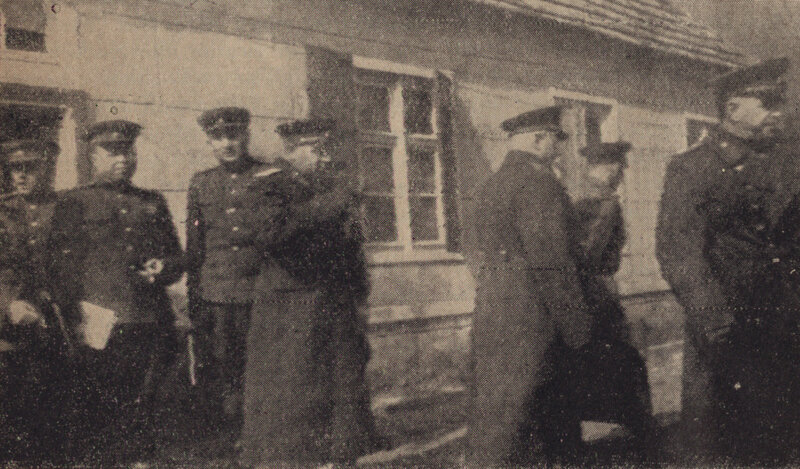
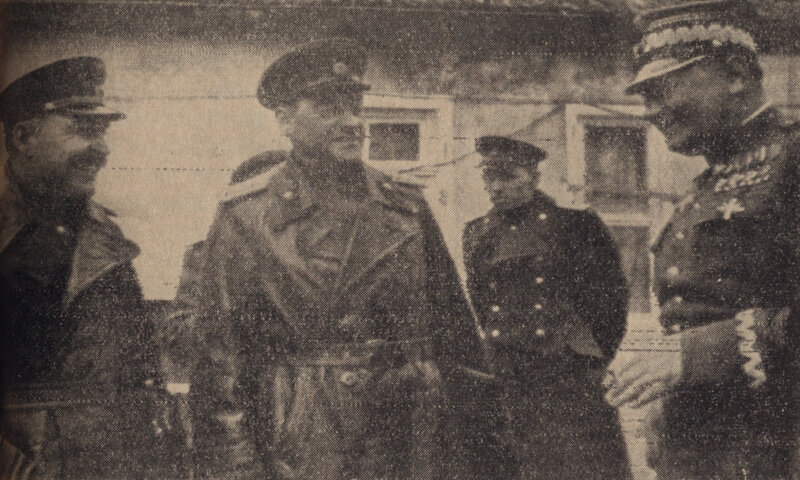
The first breakthrough from the Vistula was achieved last January by a tremendous concentration of artillery fire power. A Polish officer told me that at one place 500 pieces of heavy artillery were concentrated in a single kilometer—that is, one piece to every seven feet. This broke down nine successive lines of German fortifications between the Vistula ad the Oder. Parts of Zhukov’s army advanced 342 miles in slightly more than a fortnight, reaching the environs of Kuestrin early in February.
It is well to note the General Staff’s superb maneuvering whereby different Soviet armies fitted in and protected each other’s flanks. Konev began and two days later Zhukov and Rokossovsky followed. Each army swept onward in the most daring maneuvers, surrounding big cities and taking them from unexpected sides. This was possible only through correlation that was both complete and on a tremendous scale.
Tanks raced down the main highway without halting for anything. Americans were especially amazed to note how they drove on, lights blazing at night through enemy territory, which soldiers perched daringly outside. It was the function of these outside men to clear minor roadblocks and silence anti-tank guns. The tanks by-passed all fortresses, leaving them for later attention, often a hundred miles in the rear. The most daring action was justified by results.
Some distance behind the tanks came the main body of infantry, marching in loose formation but with a single aim—to get rapidly to the front in every possible conveyance. They chiefly used horses, since precious motor transport was reserved to service tanks with gasoline and shells. This concentration on essentials was one of the most vital factors enabling the Red Army to go so far in a single drive.
Americans were struck by soldiers driving small peasant carts on which two men slept while two drove, thus proceeding during the twenty-four hours of the day. When the horses were worn out they picked up others along the road. Similarly, they picked up food without waiting for the heavy transport supplies and, likewise, they gathered tremendous stores of enemy ammunition and adjusted many types of guns on a single front.
Gasoline was brought up in every type of container. Besides ordinary tank cars, Americans noted how the Russians dug up underground cisterns and fastened them to flatcars to transport extra gasoline.
“We learned a lot about war,” one American captain told me. “The Russians combined much individual initiative with a gigantic collective drive.”
This drive set the first bridgeheads over the Oder last February. Then came the news blackout on Zhukov’s front and the Moscow press gave attention to the battles in Austria and Czechoslovakia. But everyone knew the tremendous supplies being heaped up behind hard-won Oder bridgeheads for the final smash to Berlin. The enemy also knew and attempted many counterattacks on the bridgeheads but without success.
The final Berlin drive began April 16, but the Moscow papers announced it only seven days later, when the Red Army was already far advanced. Then the news broke. How the bridgeheads had been suddenly widened by thousands of pieces of artillery and entire divisions. How other divisions forced the river making new bridgeheads and advancing along the tremendous front.
“Nobody who was there will ever forget that dawn in the Oder when we went into action for the drive on Berlin,” wrote Roman Karmen, famous camera-man and reporter, in Izvestia. “With thousands of guns roaring, the whole Soviet land was moving on the enemy’s capital over a score of roads.”
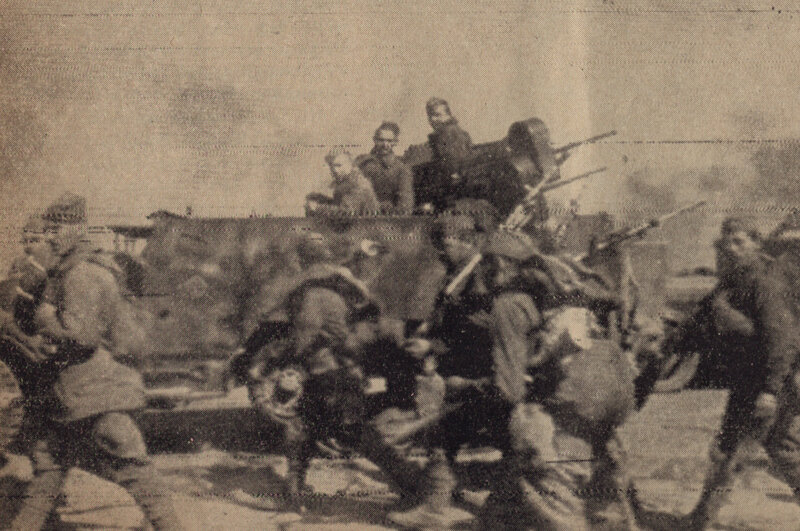
On the left flank, the First Polish Army forced an additional crossing over the Oder under enemy fire. “They went like a triumphal march,” General Rola-Zymierski told me a week later in Moscow. “They drank the water of the Oder as a toast to victory. It was their greatest pride that despite the difficult river barrier they had caught up with the Red Army and continued alongside.”
Every Soviet writer stressed the tremendous network of highways leading to Berlin. The Russians are unaccustomed to so many four- and six-lane roads.
Kudrevatikh, in Izvestia, wrote: “Dozens of highways, railways and parkways all lead to Berlin. The avenues are lined with blooming cherry trees and waving bitches. And all these roads, the big ones and the little ones, are filled by the Red Army. On some roll tanks, on others the cavalry, and on still others, automobiles with gasoline, shells, bombs and mines.”
Throughout the advance there was constant fighting which increased in fierceness as they approached Berlin. Soviet writers personalize many individuals of whom I will mention but two.
Machine-gunner Boris Norov had not closed his eyes for three days and nights. So, during a short halt he dropped into sleep behind the shelter of a broken wall. Through the deafening explosions of enemy shells and the roar of Soviet artillery behind him he slept a blessed sleep. Finally a mortar burst nearby covered him with mud and gravel and awakened him. “What were you dreaming of?” his buddies asked.
“Of my wife, whom the Germans hanged,” he replied.
His bitter words spurred the attack. Everyone had personal accounts to settle with the Nazis.
Young Gregory, a machine-gunner, was blocked by a fortified enemy machine-gun nest. He left his own gun with a buddy, took a grenade, crept around some houses and made a dash, thus silencing the opposition and opening another road to Berlin. Who is this Gregory? Captain Andreyev, telling his story in Red Star shows that he is just a typical Soviet doughboy. He was riding horseback across the wide prairie, returning from his morning swim in the Volga, when the village bells rang out on June 22, 1941—a summons to the village square. Thus mobilized, he said goodbye to his mother. He remembers how she stood in the dusty road with red swollen eyes. He remembers his first battles, the first time he faced the enemy. He remembers the months of bitterest retreat. And the time his buddy, Anton, lay wounded on his machine-gun with the Germans almost upon them. The belt was jammed. He straightened out the belt just as the enemy was only a few yards away. But then mortar shells exploded throwing him against Anton; both were wounded, their blood mingling in the snow.
Then the hospital—then Stalingrad—then fighting in the Kursk meadows. Then the girl he loved but never was able to tell her because she fell mortally wounded beside him and he could only carry her to the dressing station and weep. He remembers when finally they crossed the frontier to fight on foreign soil and he picked up a clump of Soviet earth and wrapped it in his handkerchief. He wanted to take Soviet land with him.
But Anton teased him: “No need to carry Soviet earth in your handkerchief. I am carrying it in my body. It is cut into me with shrapnel from all over the Soviet map. Here is a bit from Moscow, here from the Volga, here from the Dnieper, here is the earth of Stalingrad.”
Such were the boys who were advancing down all those German roads.
Six days after leaving the Oder, Red Army artillery was firing into the center of Berlin. Karmen notes how it happened. “We set up our guns near Bisdorf and asked, ‘What target?’ ‘Take the center of the city, take Friedrichstrasse, the bridge across the Spree, Stettiner Bahnof.’
“As the guns roared I noted the hour. It was 8:30 a.m., April 22.”
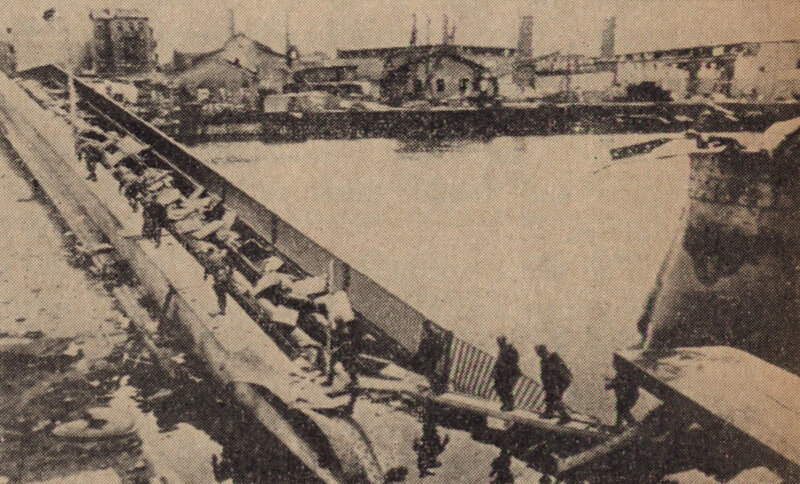
As the fighting penetrated the city, its character changed. It became a many-storied battle on the streets, on the roofs, in different parts of buildings and even underground. Captain Gekhman in Red Star describes the complicated nature of this stage of the battle.
“Here the infantry holds the surface, but the battle continues above in the upper stories while in subway tunnels it has gone ahead half a mile.
“We go down the street toward the regimental staff headquarters. The battle seems a considerable distance away. Suddenly a Red Army tommy-gunner sticks his head around a corner, signals to us to duck back into a driveway. Later, after making his way through the backyards, he reaches us and says: ‘If you had gone ten yards further they’d have dropped a grenade on you from the window. Two floors of that house are still full of Germans. I am stationed here with a platoon to see whether they will run up a white flag or try to fight their way out. We are ready in either case’.”
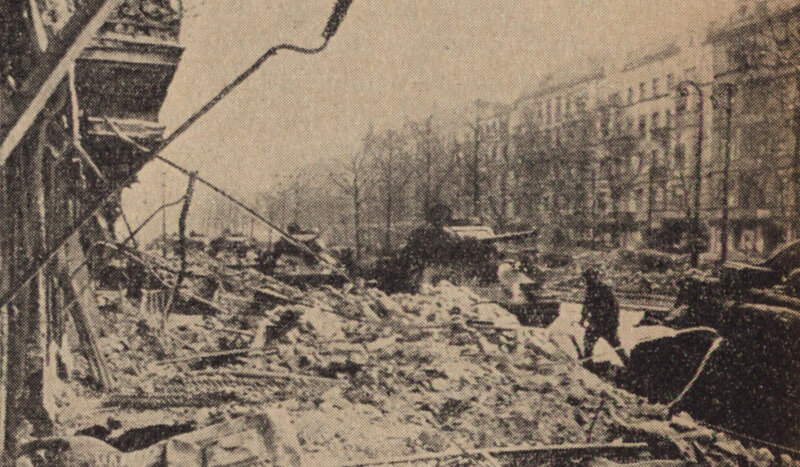
When Gekhman reached the headquarters he asked why they moved ahead without clearing the block behind them. They told him, “The fighting here is very complicated. We could have blown the top off the house from which the Germans are firing but we have information that 200 Russian and Ukrainan hostages are in the upper floors. We try to dislodge the enemy without slaughtering our people. Besides we must consider the different types of German fighters and how they act. Besides the SS and regular army there are a lot of Volksturm troops who a fortnight ago were firemen or traffic police. Those folks don’t know how to fight when they are cut off from the army. They’ll hang out the white flag when they are left five blocks in our rear. By moving ahead we demoralize such fellows without wasting men.”
All Soviet writers noted the large numbers Russian, Polish and Yugoslav civilians that were held as slaves in Berlin factories and are now freed by the Red Army advance. Major Borsenko tells how sharpshooter Konstantin Salov came into a large factory that made silk for parachutes. The enemy was still firing from the roof but the factory was still operating. From the holes shot into it, the smoke from the chimney poured into the air. Suddenly a crowd of Russian women who had been working under the threat of guns rushed out to freedom, embracing the new arrivals.
Salov looked at them with mingled joy and pain. His own wife had been taken by the Germans from her home in Kramatorsk and had disappeared like a stone dropped into the sea. He couldn’t resist asking the women, “Have you seen Vera Salova?” No, no one had seen her. But an old woman said, “Hurry up, son, there are many more Russian women slaves in this city. Maybe you’ll find her still.”
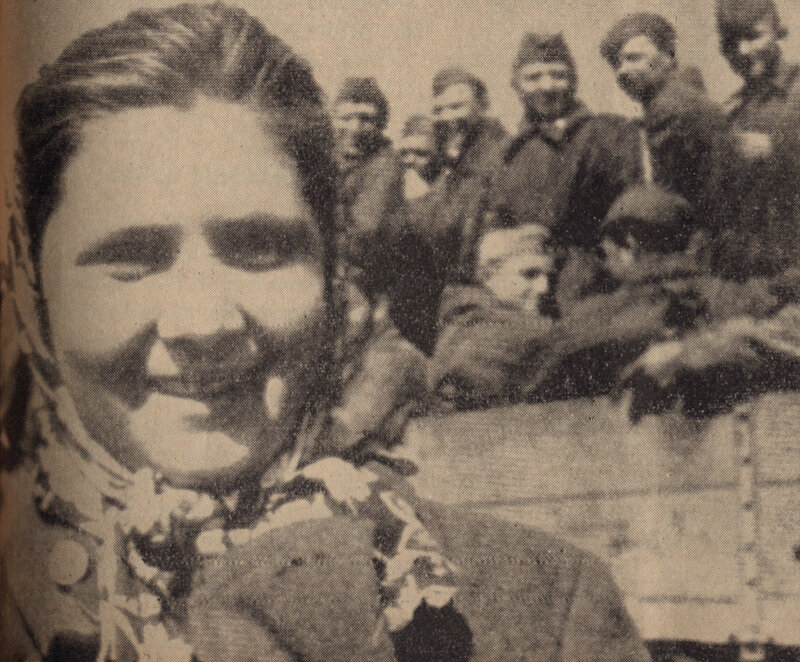
Another correspondent, Zolin, tells of an old Russian woman asking, “My little dears, which is the way to Orel?” The soldiers smile. “We’ll send you there Grandma.” They put her on a truck going to the rear.
There are scores of striking incidents mentioned by Soviet writers. Gorbatov, in Pravda, tells of a Berlin wall inscription in oil paint, “1918 won’t be repeated.” Chalk marks have crossed this out and under it is written, “I am in Berlin,” and it is signed, “Sidorov.”
An aged German approaches the army. He is selling guide books and maps of Berlin. The guidebooks are priced at one rentenmark, but the old man says he would be honored if the Red Army men would accept them as a gift.
Titenkov, in Komsomolskaya Pravda, tells how a German in civilian clothes offered five cigars to an artillery commander. He made his offering with a deep bow as though he wished to placate the conqueror. The commander, suspicious, examined the cigars and found them full of explosives.
The same writer accompanied Red Army men into a fifth floor apartment where a very polite man welcomed them and showed them many anti-fascist books. They took a large volume of Tolstoy from the shelf and discovered Mein Kampf hidden behind it.
The well-known writer, Vsevelod Ivanov, tells how a Soviet cameraman makes a record of the Germans in the very act of looting food shops, while the proprietors try to guard their possessions and the battle rages a quarter of a mile away. “Then we go further. Here the Germans no longer stand guard over their property but hide in cellars for machine-gun fire is very hot.”
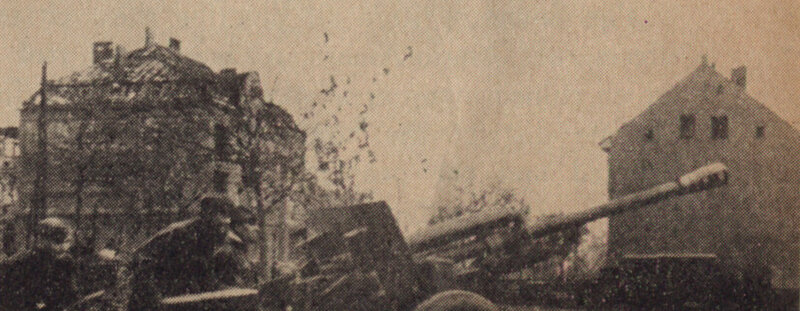
The Soviet writers all describe the effects of Anglo-American bombing which ruined many areas of the capital. In one district the houses had been levelled and the people lived in the cellars. In another, there had been no electric light or water for several months.
After a week of Red Army fighting the Soviet writers reported that the population of Berlin was demoralized and began splitting into different camps. A remarkable article by Gorbatov, in Pravda, underlines the conclusions recently voiced in the same paper by Alexandrov in an article criticizing Ehrenburg and declaring that “Germans aren’t all alike.”
“From a window hangs a white flag while from the roof comes white blazing gunfire,” writes Gorbatov. “Some surrender themselves as prisoners; others change into civilian clothes and shoot at us from around corners. In one street our major has just been killed by a shot in the back. But here comes an old man raising a clenched fist and crying ‘Rot Front.’ His documents prove he is just out of a Nazi prison. A sixteen-year-old cries, ‘Hitler destroyed Germany, I hate his guts.’ But other sixteen-year-olds operate an underground telephone and inform SS men of the location of our staff.
“Everything is confusion today in the German people and in the German individual soul. They are shaken, scared, beaten. They are splitting different ways.”
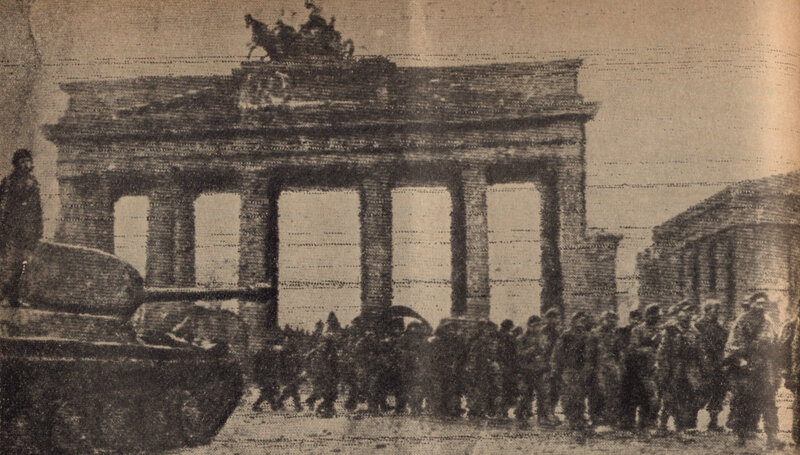
Gorbatov notes two general facts about the civilians of Berlin. Most of them have been living in such terror of the Anglo-American bombs and the assault on Germany that their chief desire is that the war should end.
“There are two Berlins,” Gorbatov writes. “The city we see on the surface and the city living underground in the cellars and just beginning to emerge into the daylight. Old men and women, young mothers with babies have crouched for months in cellars. They began to live there when the violent Anglo-American air attacks began.
“Little by little, during the long hours of bombing, they brought down to the cellars their mattresses, chairs, tables, cradles, kettles. Thus, underground life began, and continued. These ordinary civilians coming up to the surface want only one thing—just to live, just to have an end of horrors, to have order, to have peace. Soviet shells and Anglo-American bombs have cleared the air for them, have dissipated the Hitler fog. They know now that war criminals will be brought to judgment. They know that Germany will pay for the war. They are trooping into the offices of the Red Army military commandants and asking, ‘Can we move upstairs from the cellars? Can we lock our doors at night? Can we trade?’ For the second fact that emerges is that these people are obedient and accustomed to take orders. And they know that the issue of the war is decided and that Germany has lost.”
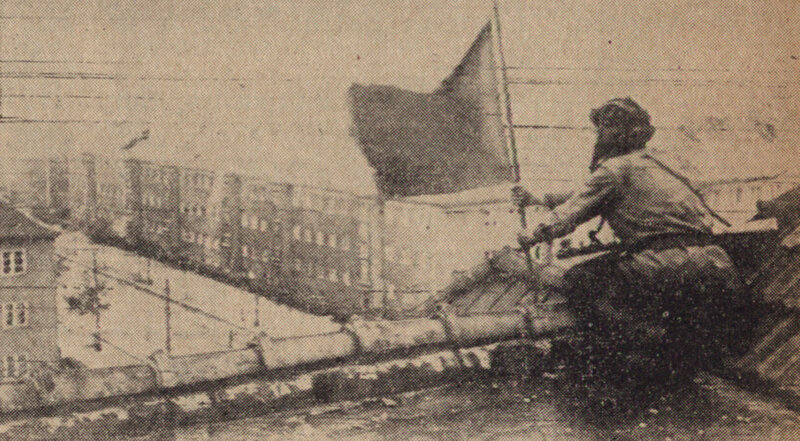
The order to cease firing was given in Berlin at 3:00 p.m., May 2. The Soviet writers noted that this was the third time Russian troops have held the German capital, once in 1760, again in 1813, and now, more than a century later.
Military victory over Nazi Germany is already decided but the problem of how to repair the terrible destruction they inflicted still remains. This destruction is not only the physical losses, the cities laid waste, the farms and industries ruined; not only the losses by death of tens of millions of human beings, but the deep destruction in the souls of the German people and in the souls they enslaved. On the political and social front the battles are not yet over and the struggle will yet be long.